Meta AI in WhatsApp groups
When AI joins a private group chat, every choice has to feel human.
WhatsApp's foundational promise is end-to-end encryption: a guarantee that no one, not even Meta or WhatsApp, can access your messages. In 2026, WhatsApp introduced Meta AI as a group member to assist with planning, image creation, and group tasks.
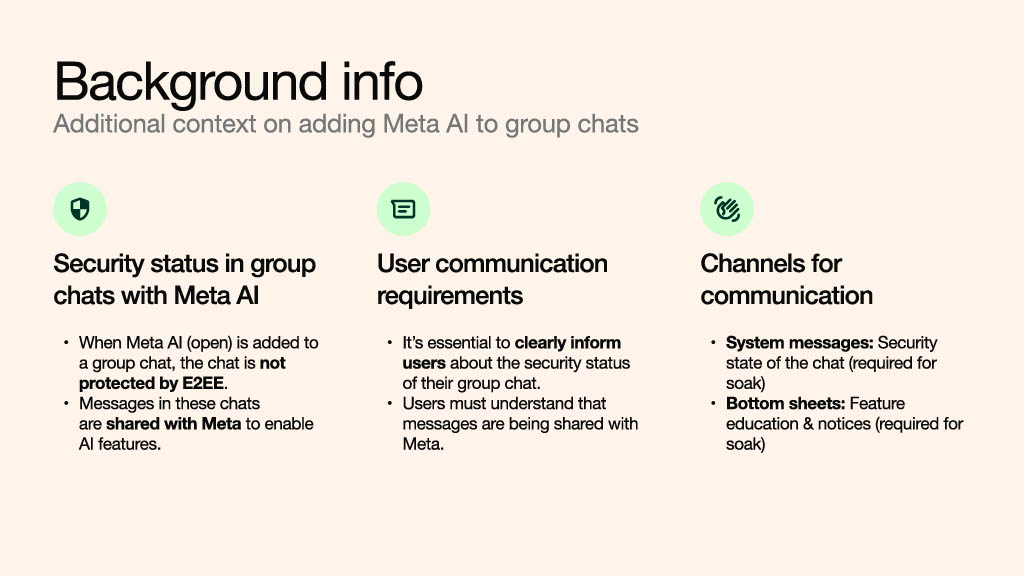
Integrating Meta's AI assistant into a private space created an unprecedented technical and social hurdle. To fuel AI utility, models must process data, which inherently requires a trade-off with traditional privacy boundaries. We launched two parallel versions of the agent to meet different user needs:
Meta AI — The most powerful, multi-modal model. It offers image creation, editing, and voice note understanding. It's powered by Meta's cloud platform, so it requires Meta to access messages to function, effectively pausing the standard end-to-end encryption state in WhatsApp.
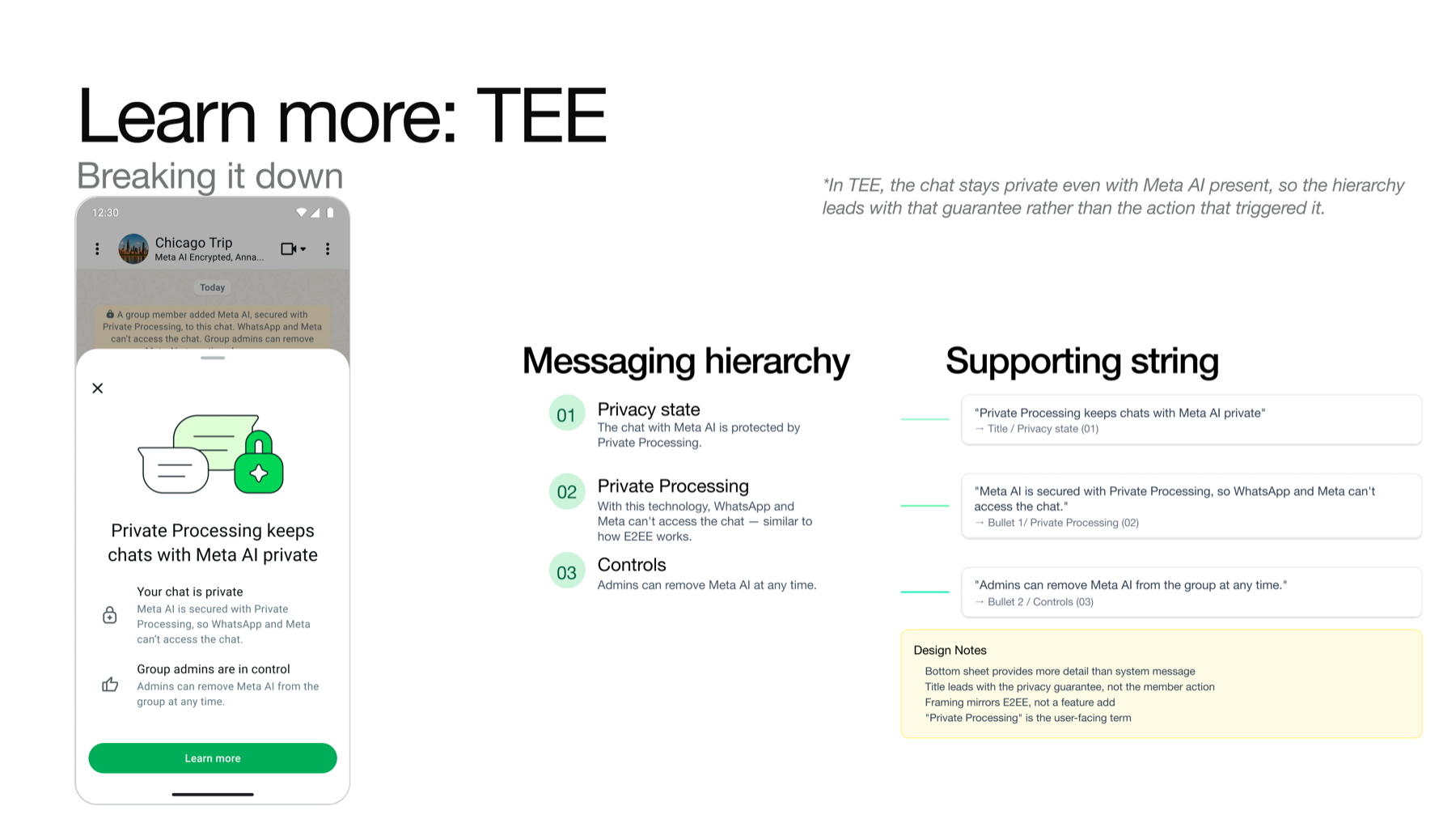
Encrypted Meta AI — A simplified, text-only version of Meta AI functioning within a Trusted Execution Environment (TEE), or more simply, "Private Processing," where messages are handled in a secure environment so Meta and WhatsApp cannot access the content.
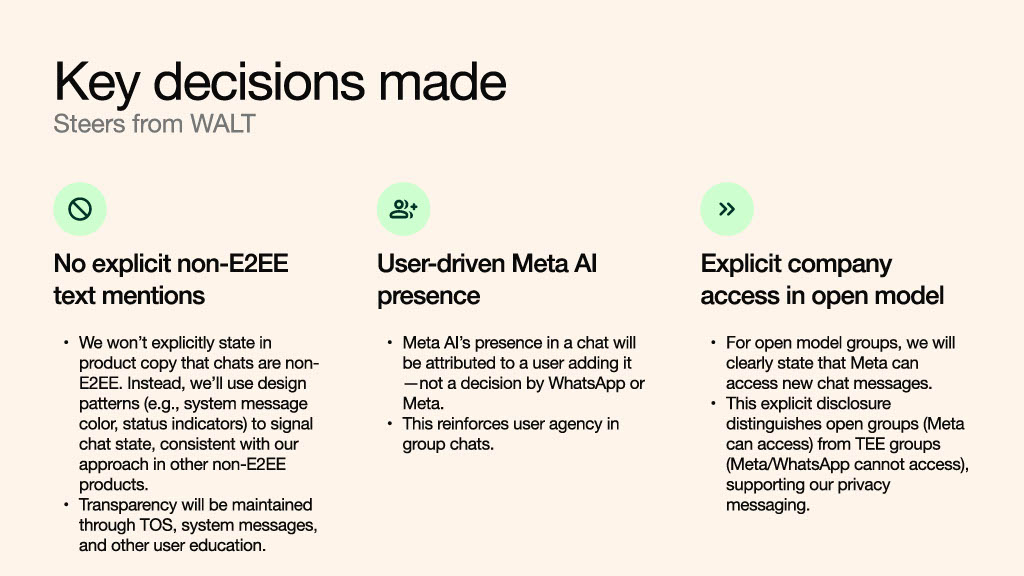
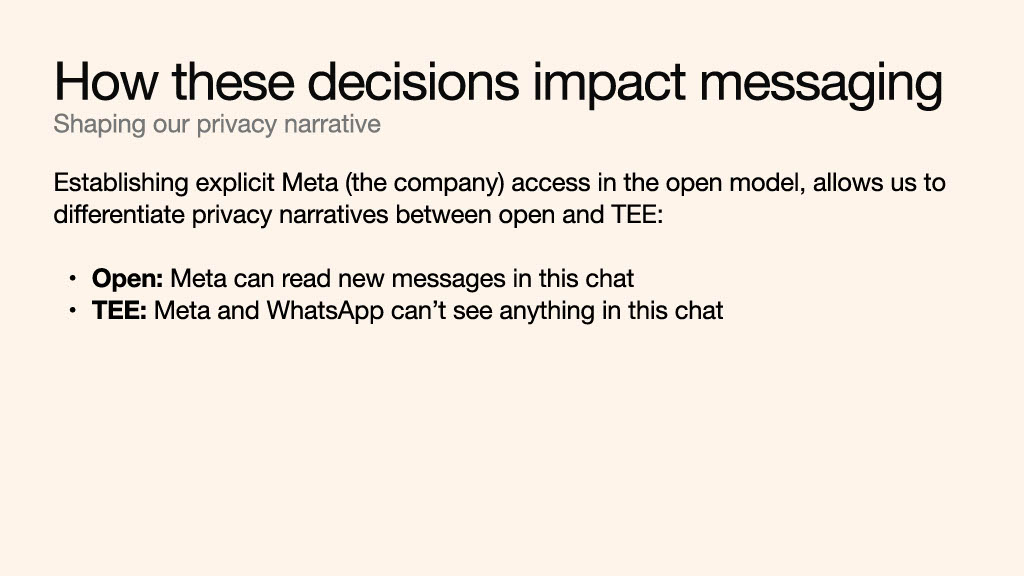
Trust Architect — informed consent as a design system.
I was the Trust Architect and UX Strategist responsible for the end-to-end system logic and information architecture. My role was to bridge the gap between complex backend engineering and the user's mental model. I had to navigate the tension between high-utility AI value and WhatsApp's privacy-first identity, aligning the Head of WhatsApp and multiple VPs on a framework that prioritized Informed Consent as a design system — ensuring it met legal requirements while driving user adoption.
Three pillars: mental model, moments of need, value-based choice.
I created a structured hierarchy to ensure all system communication followed a consistent cognitive order. This standardized how we communicated the change in encryption state across all global surfaces, making the privacy status the anchor of every interaction.
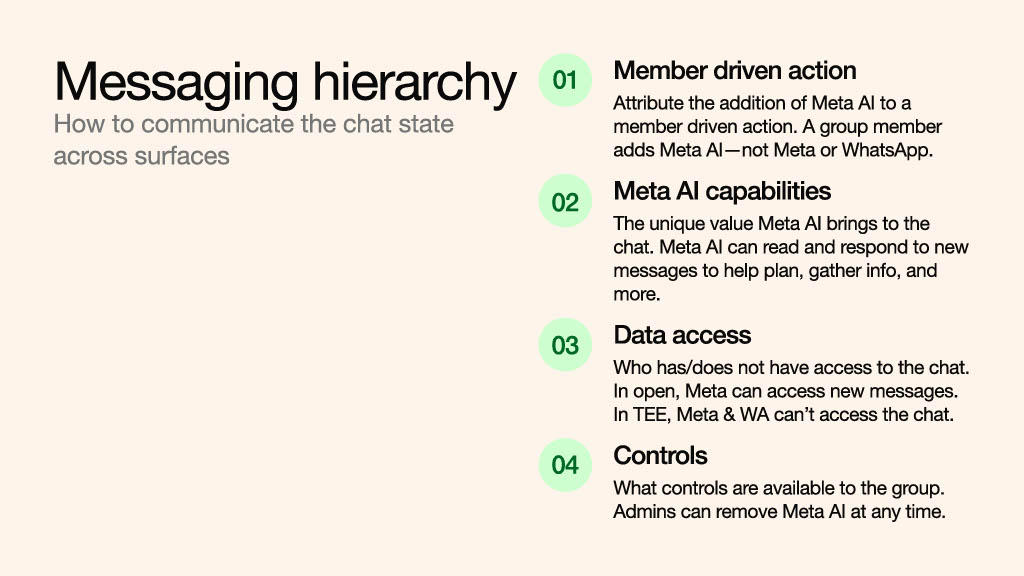
This hierarchy became the communication blueprint across join messages, contextual disclosures, and control surfaces.
Key content principles — guardrails on tone and framing underneath the hierarchy.
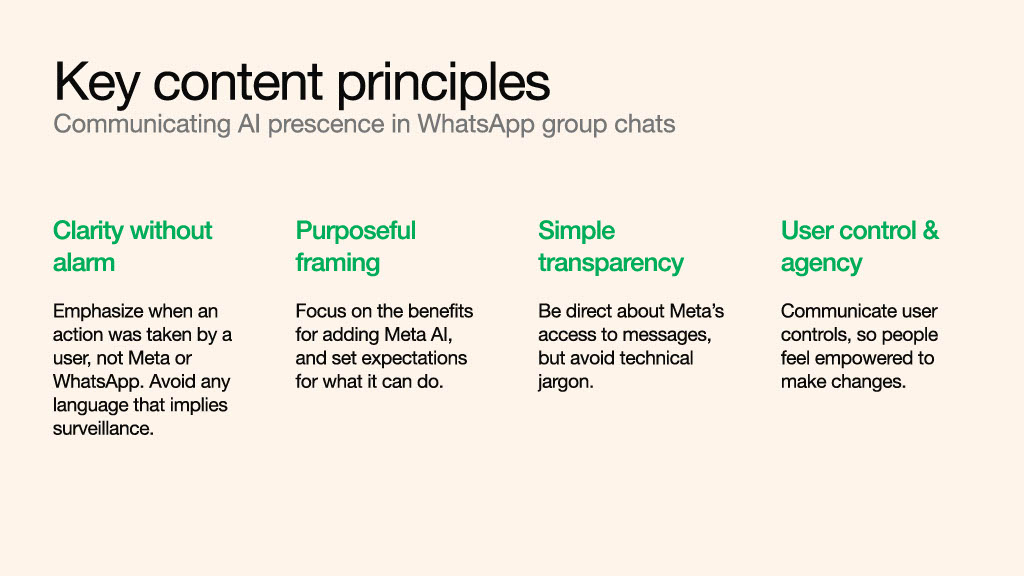
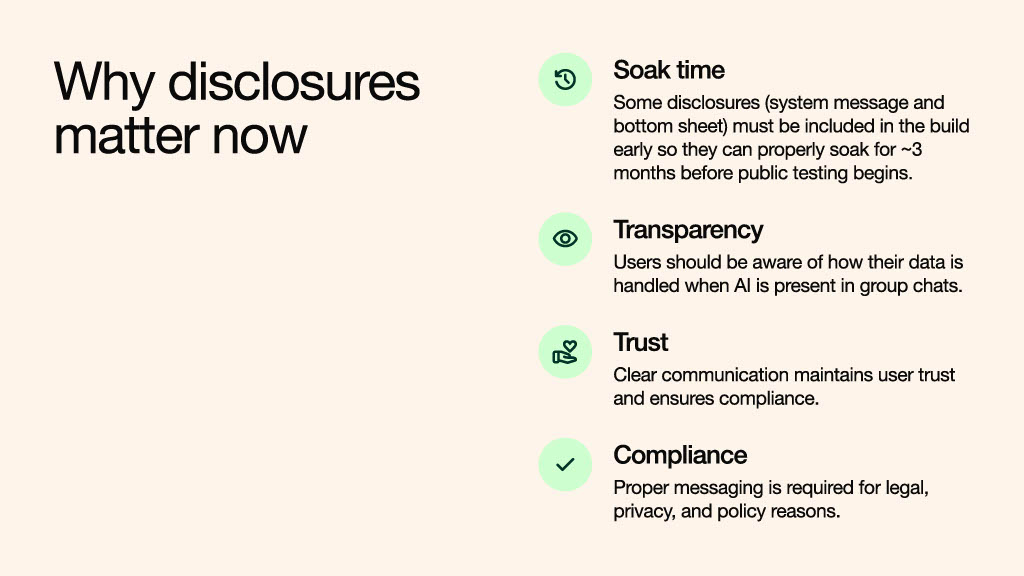
I utilized progressive disclosure to ensure users encountered security information at the exact moment of relevance.
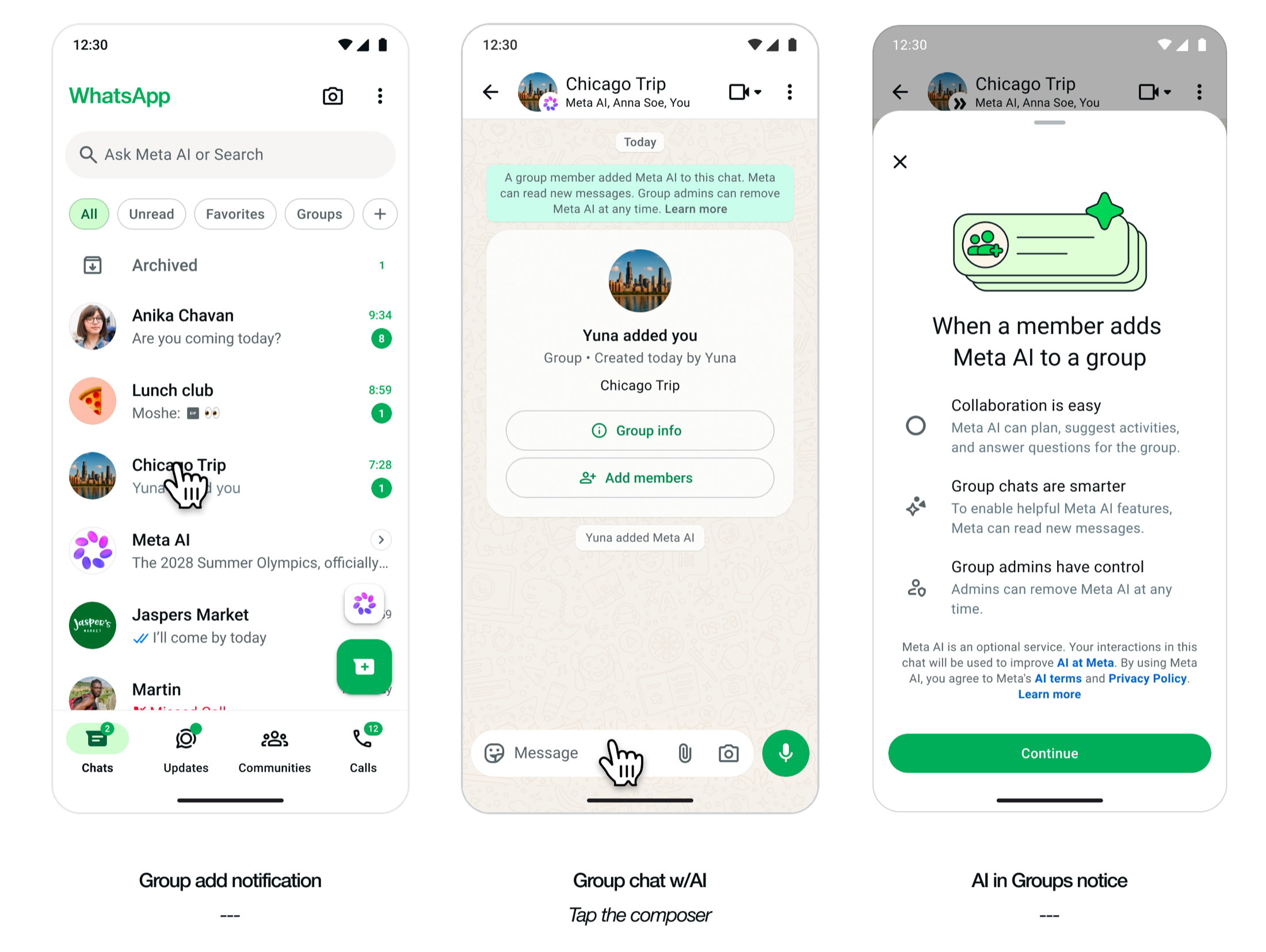
Contextual ToS NUX
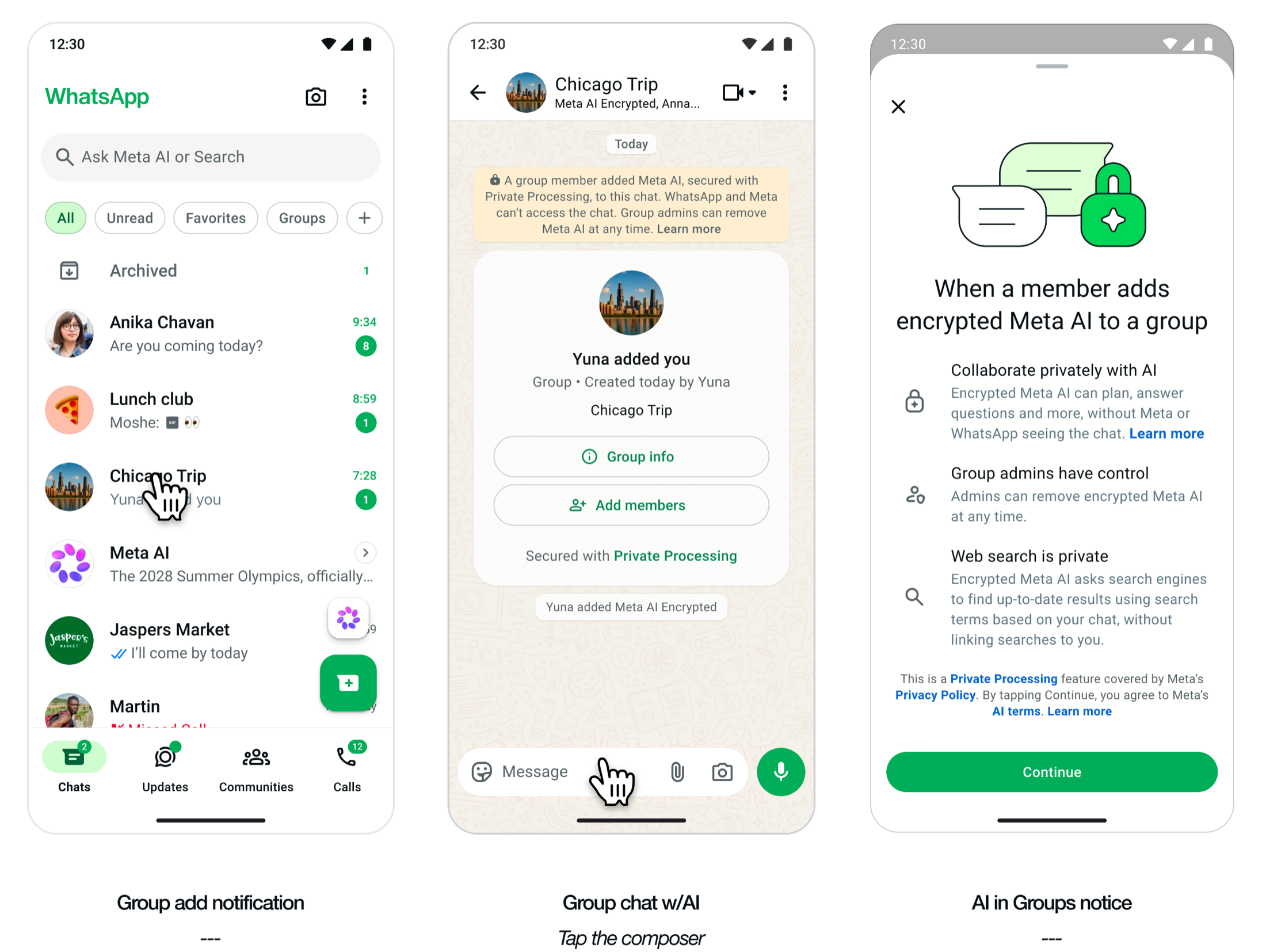
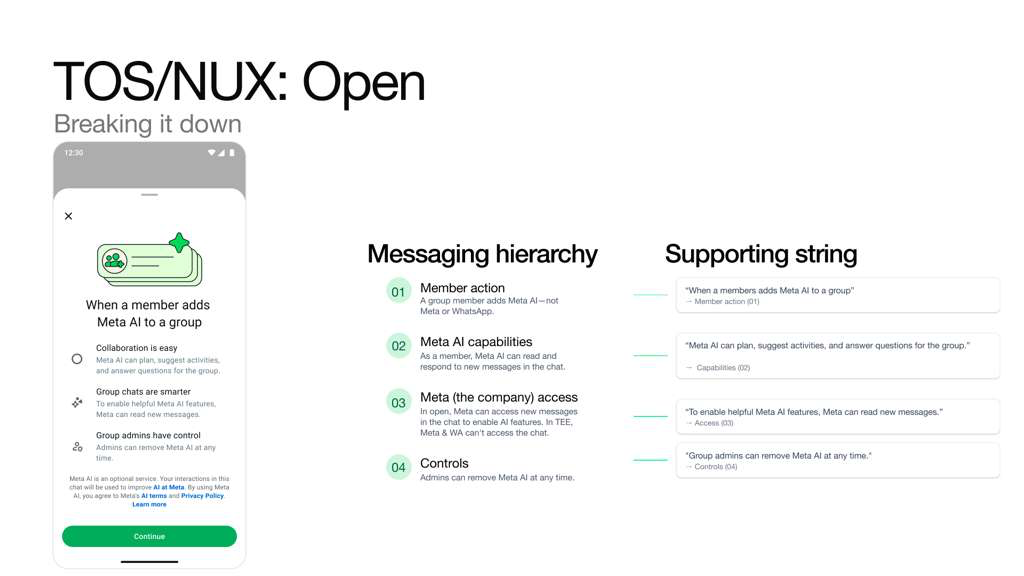
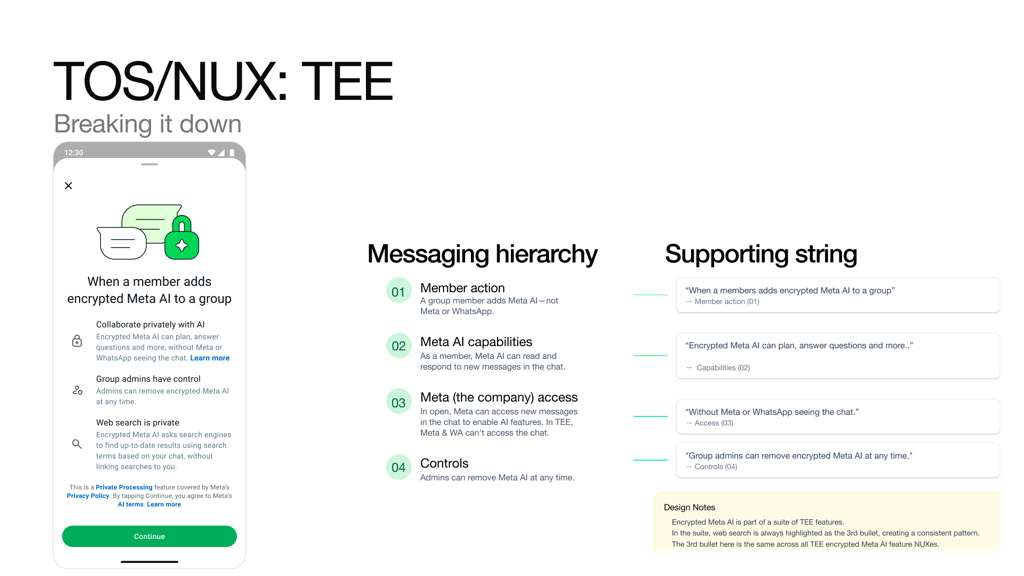
A bottom sheet surfaced when a user first encountered AI, communicating the utility value alongside legally required notice of Meta's terms and AI training.
Aligned messaging · Contextual ToS NUX · Meta AI
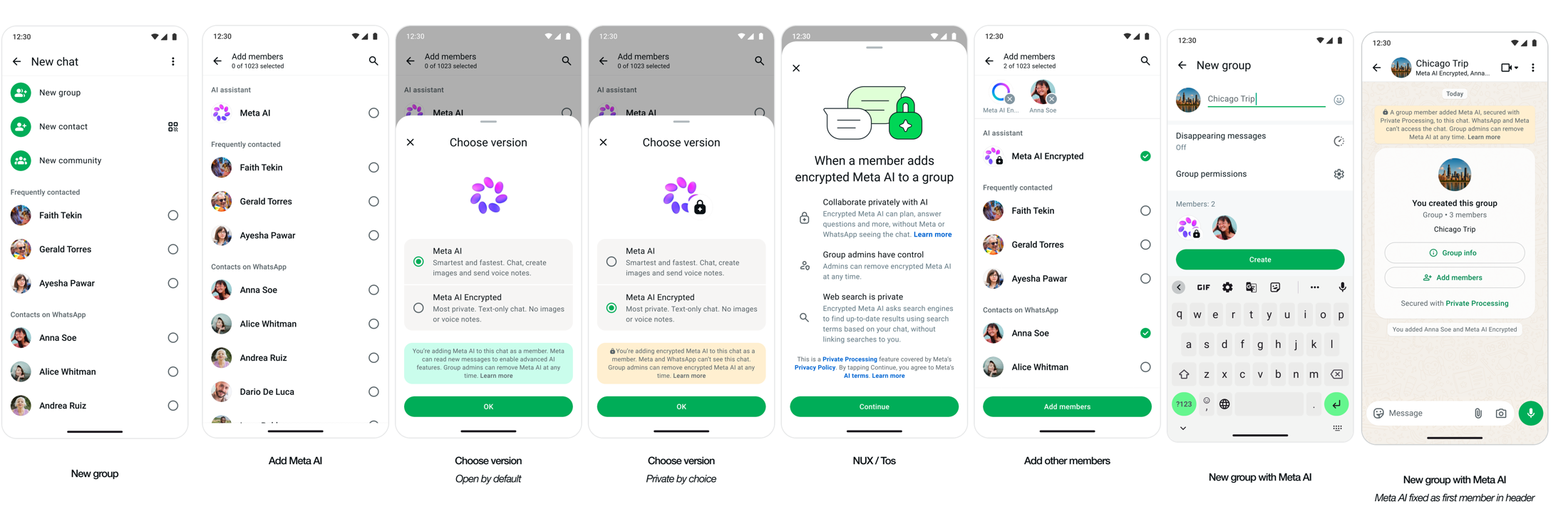
Aligned messaging · Contextual ToS NUX · Meta AI Encrypted
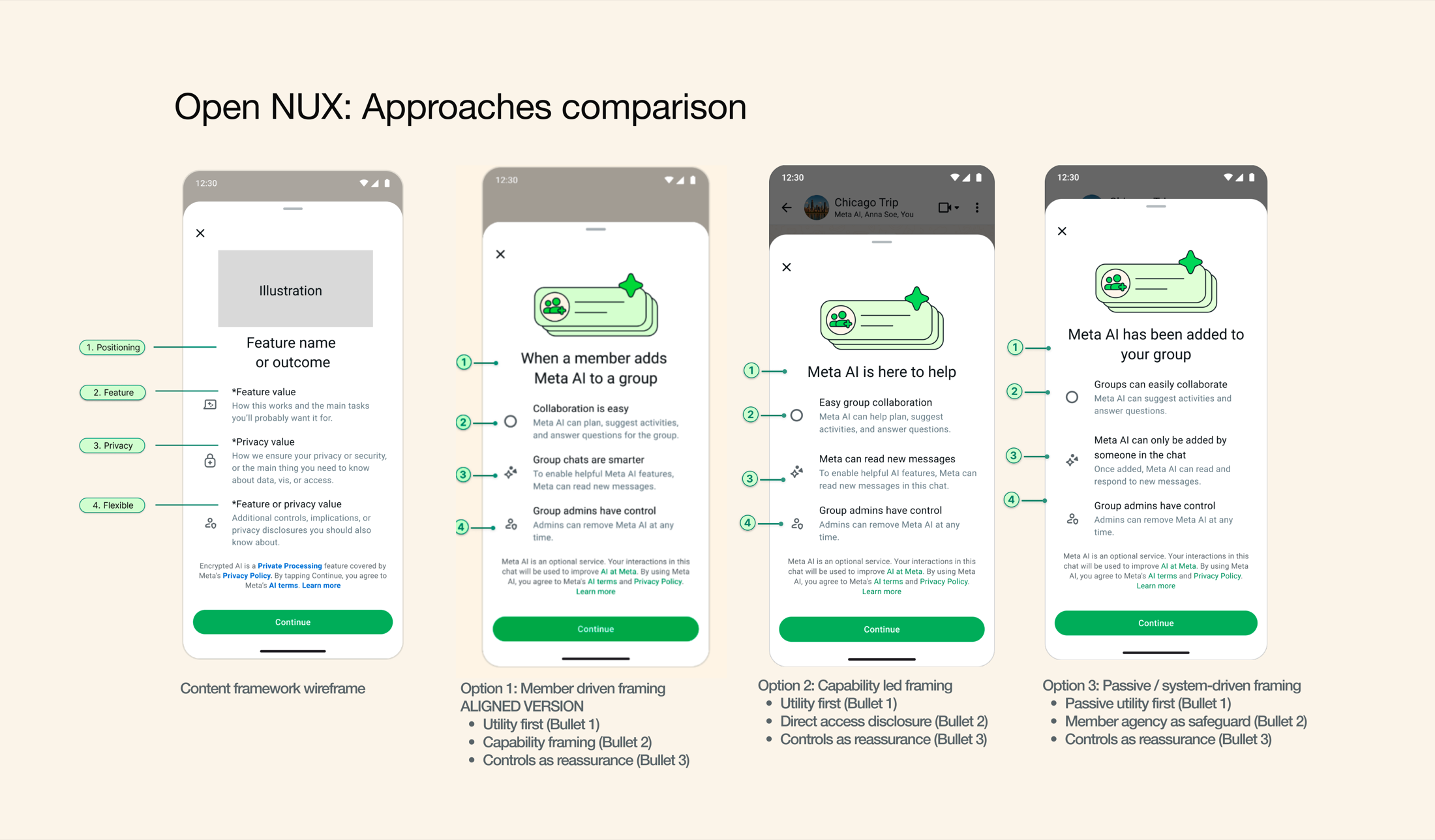
Exploration · Option set · Meta AI — framings evaluated for the same disclosures (utility, capability, agency) before we aligned on direction.
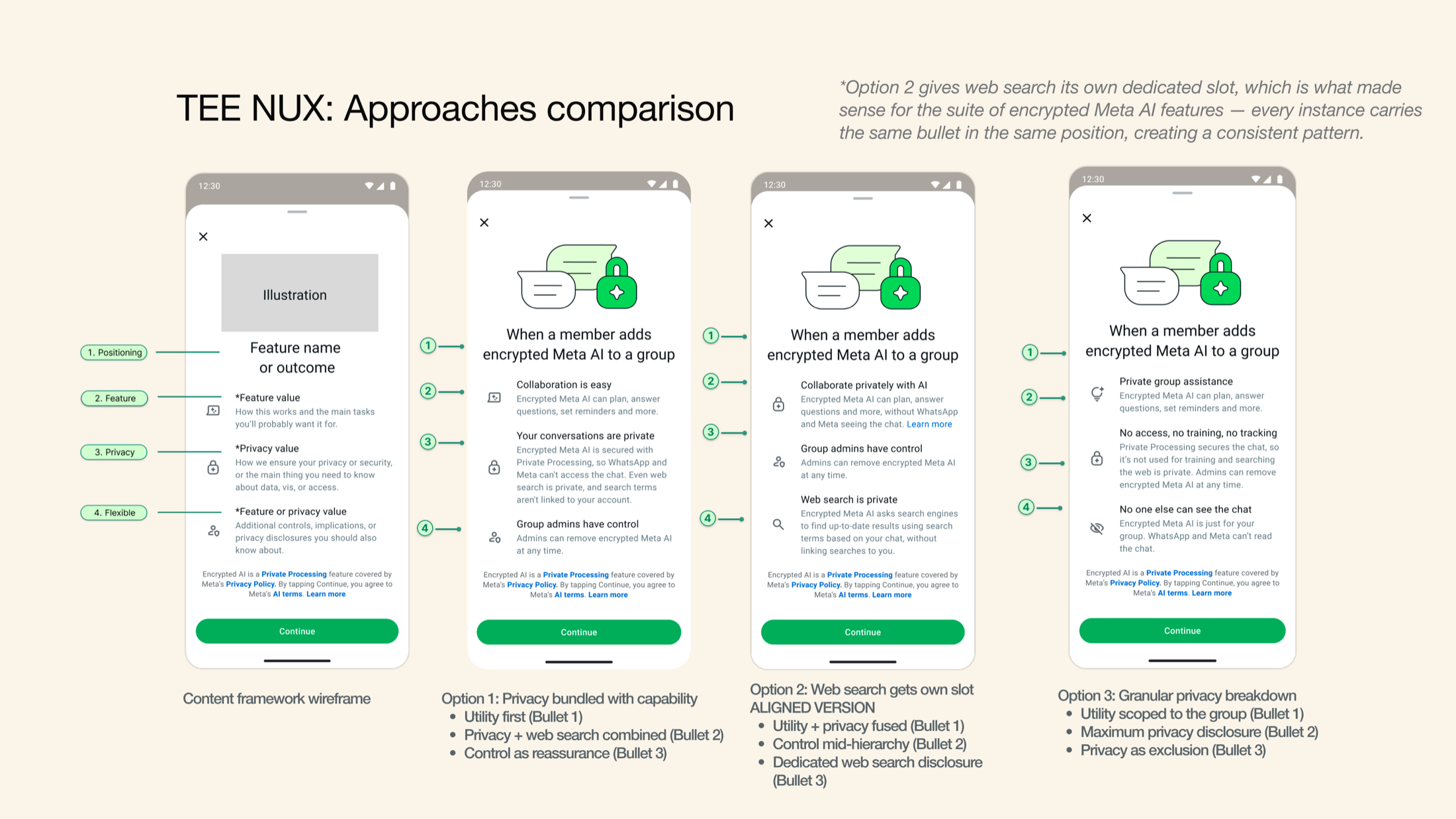
Exploration · Option set · Meta AI Encrypted (TEE) — same exercise for Private Processing: how bullets bundle privacy vs capability vs web search.
Real-time system messages
I designed the logic for notifications triggered when an agent joined. These served as the primary vehicle for distinguishing the security state — explicitly stating when Meta has access to the chat (Meta AI) vs. when they do not (Meta AI Encrypted).
Aligned messaging · System messages · Meta AI
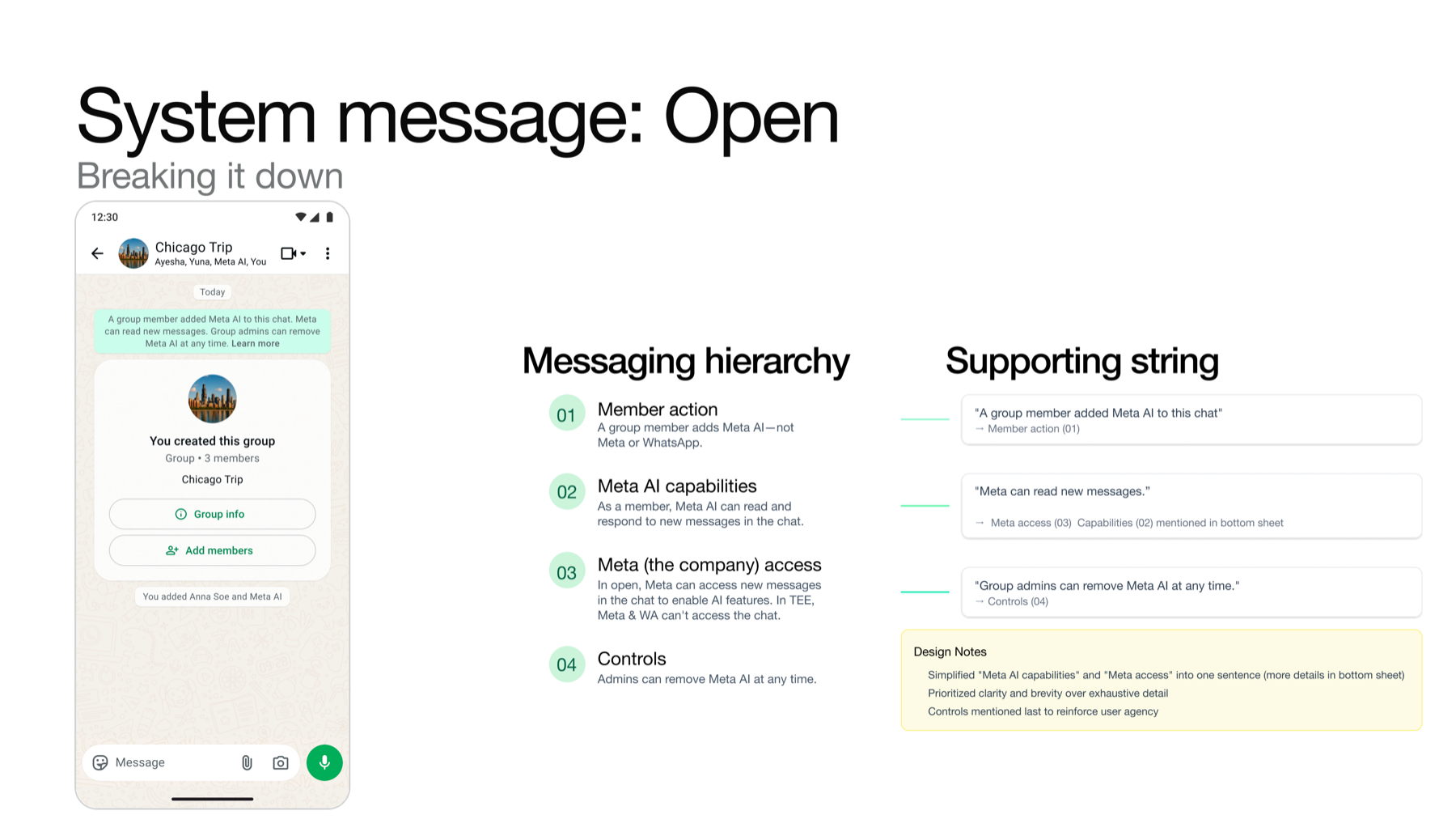
Aligned messaging · System messages · Meta AI Encrypted
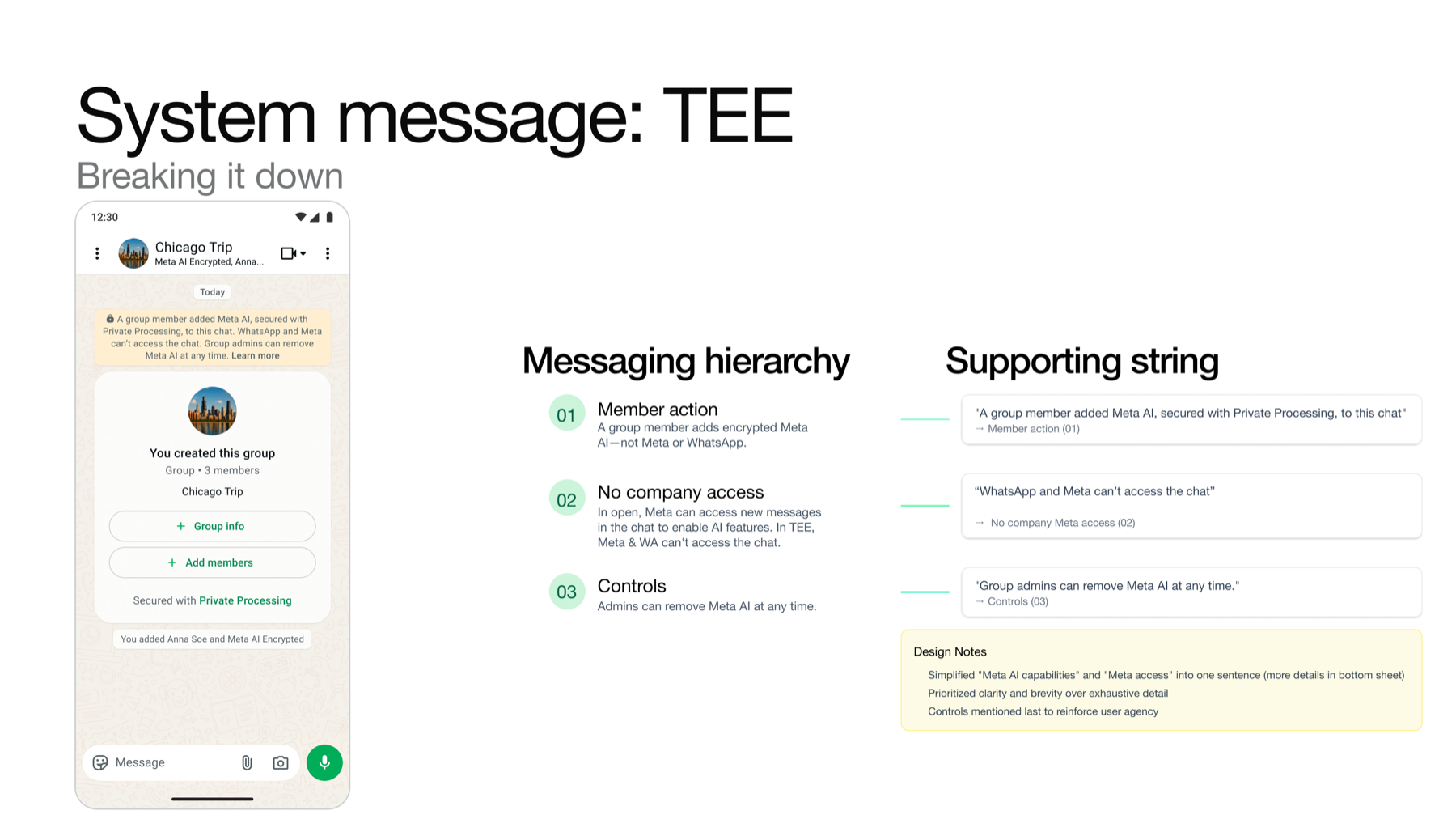
Exploration · Option set · Transparency approaches comparison
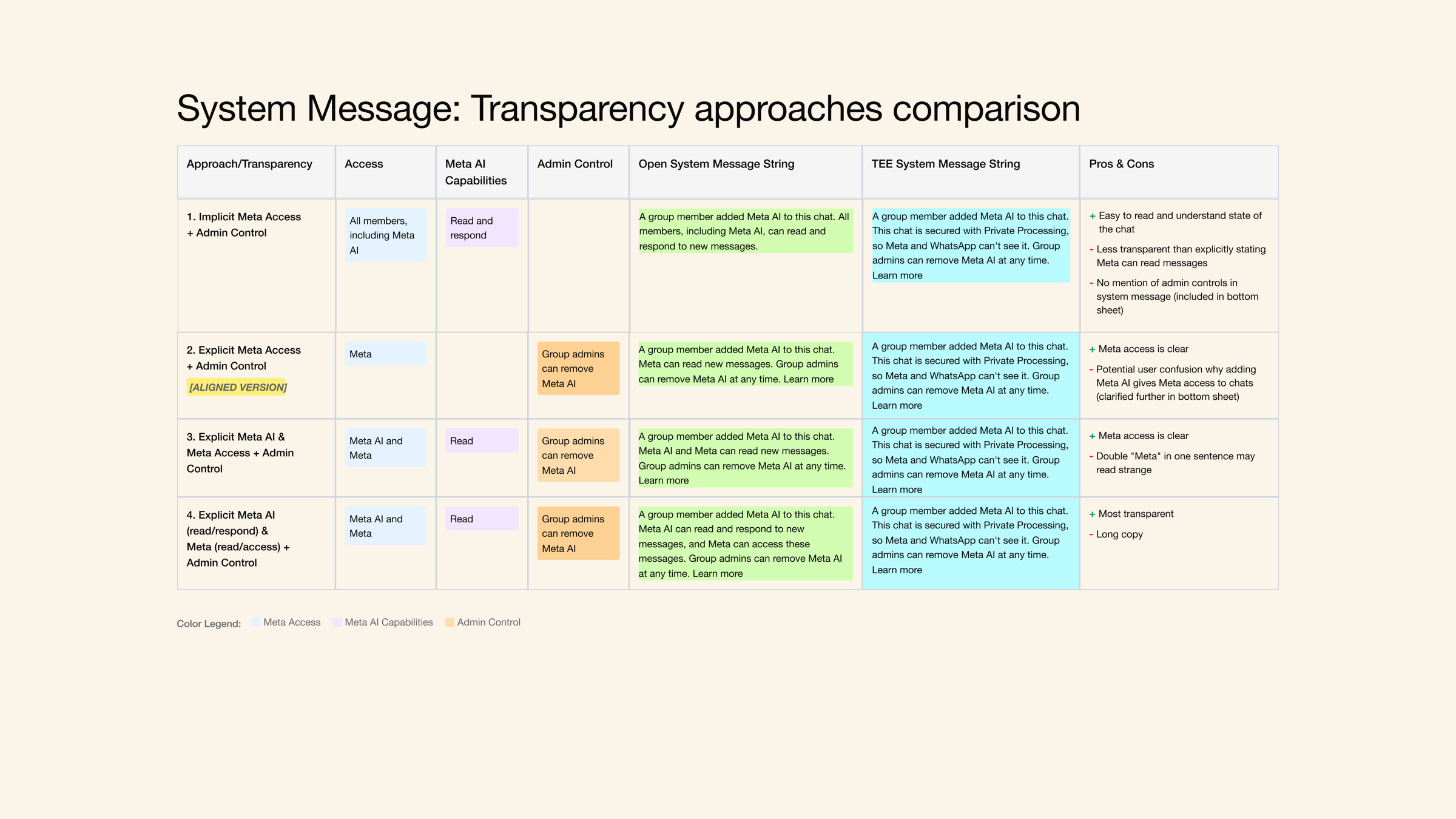
Transparency surfaces
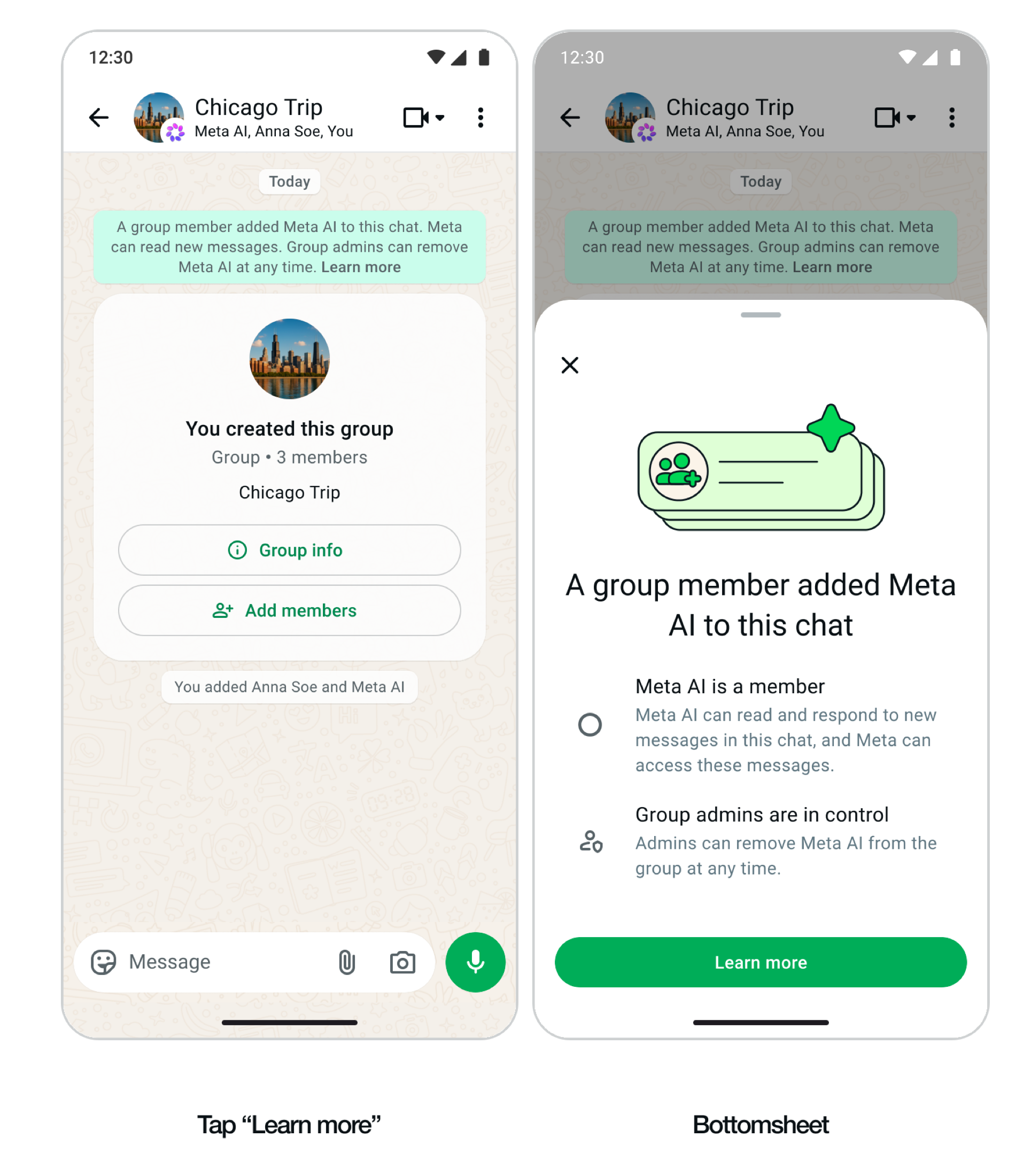
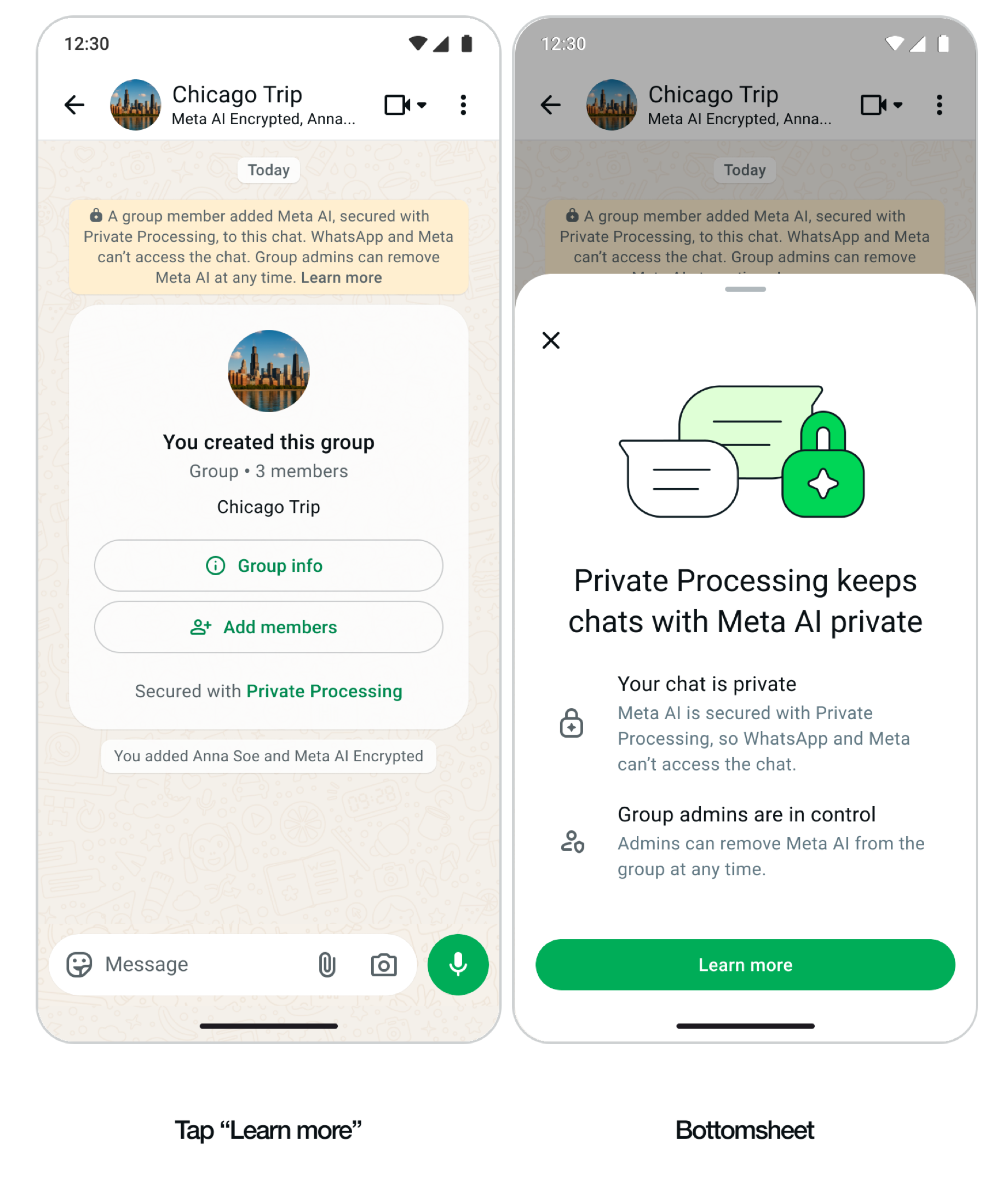
On-demand entry points for power users to explore the nuances of the AI group member's capabilities and the chat's overall security state — without cluttering the UI.
Aligned messaging · Learn more bottom sheet · Meta AI
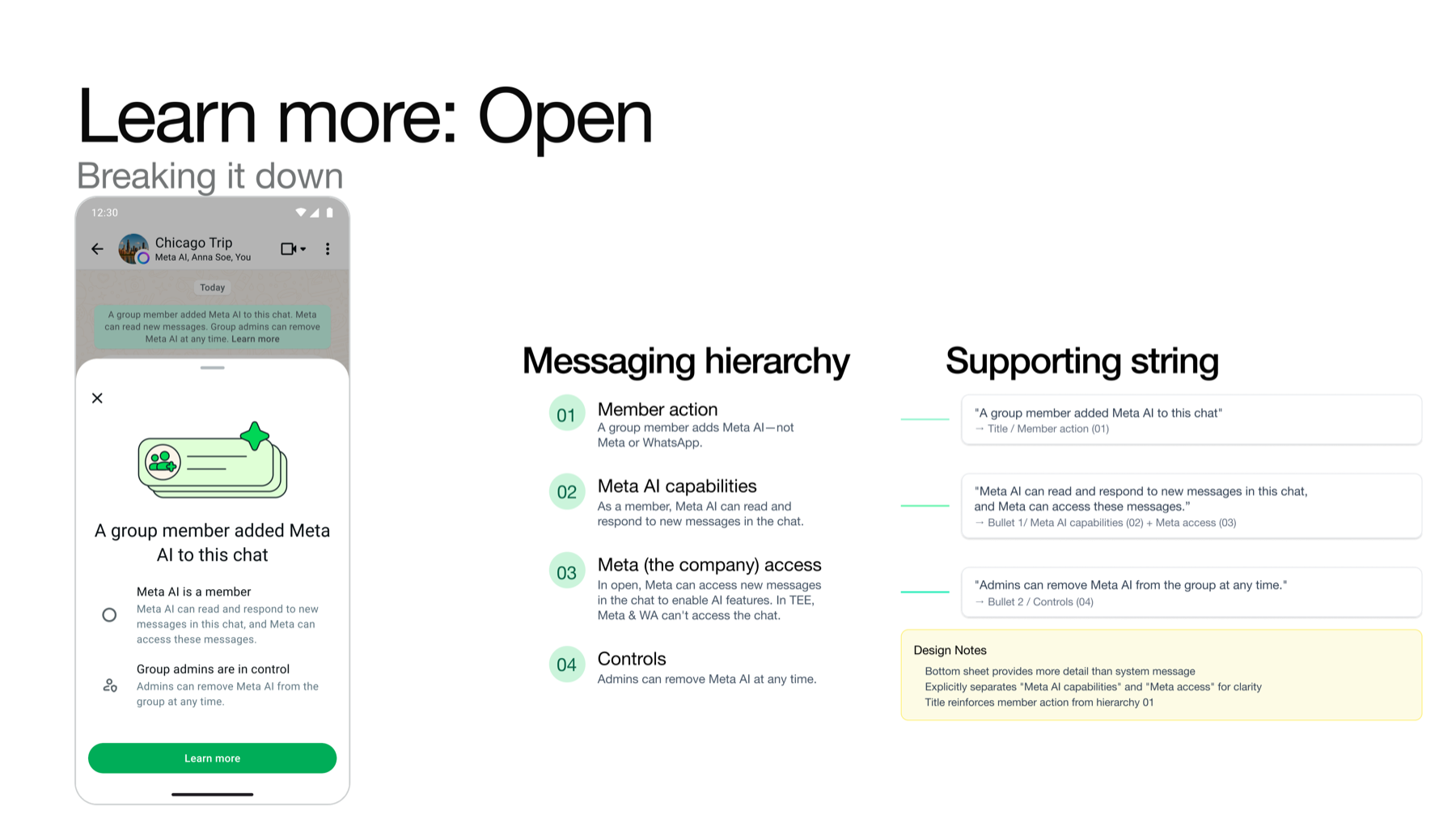
Aligned messaging · Learn more bottom sheet · Meta AI Encrypted
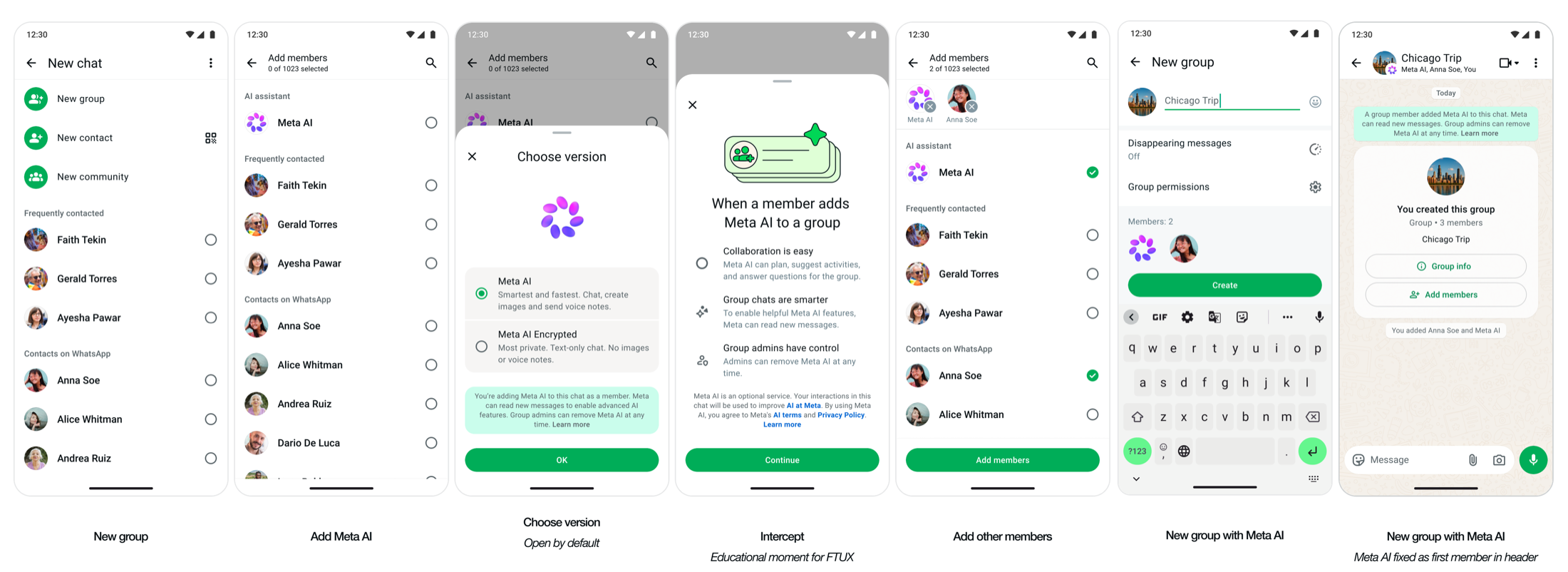
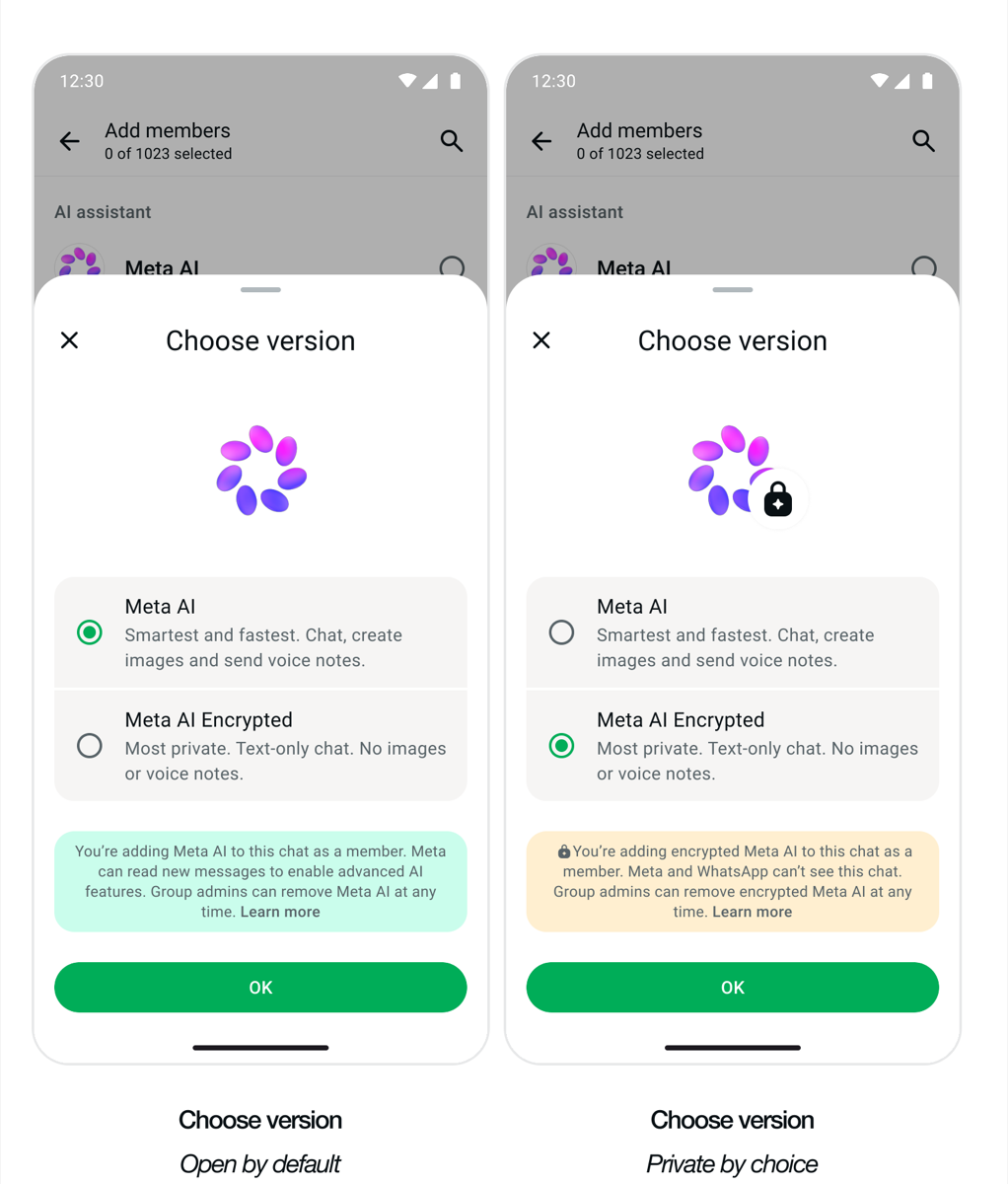
I moved away from technical jargon and positioned the two models through the lens of user-centric trade-offs. This allowed users to select an agent based on the specific needs of their group:
| Model | Positioning | What it means for the group |
|---|---|---|
| Meta AI | The "Smartest & Fastest" choice | Maximum capability — full multi-modal tasks (images, voice notes), powered by the Meta platform. |
| Encrypted Meta AI | The "Most Private" choice | Privacy-first, text-only chat — Meta and WhatsApp can't access the content. |
Aligned messaging · Choose version — model picker
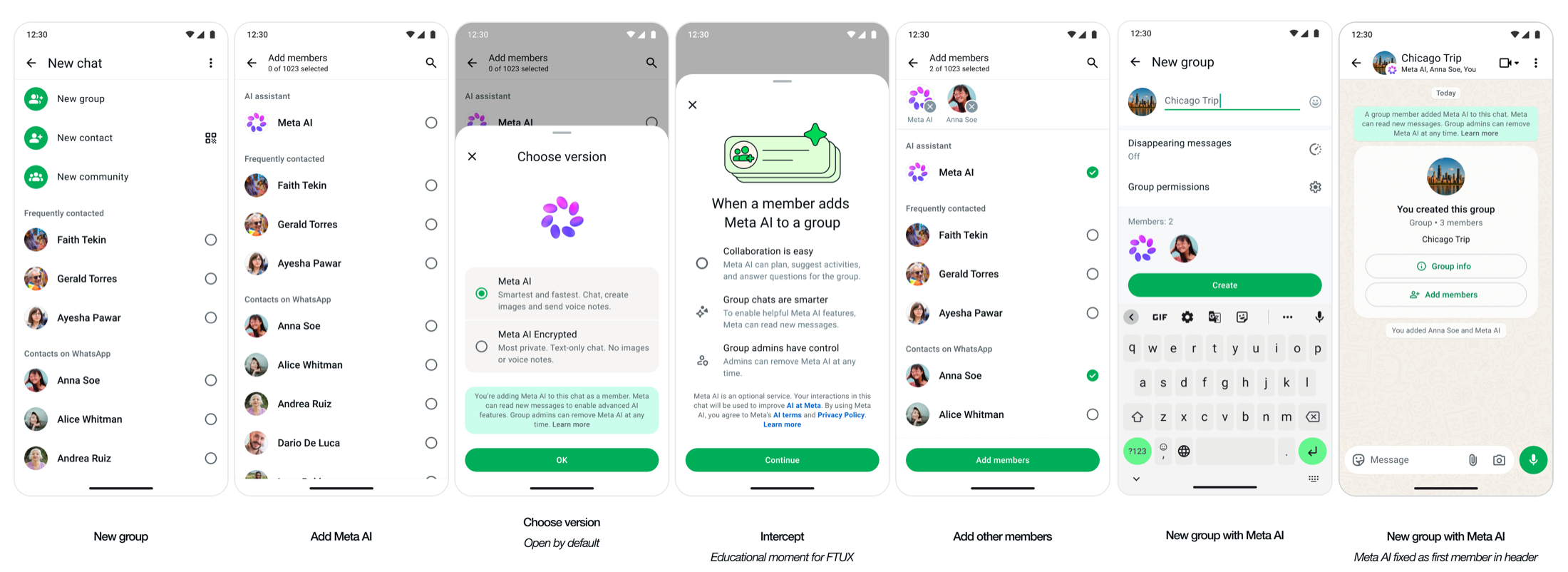
UX flows
Full flow — new group creation
Learn more — bottom sheet
Receiver-side NUX
Full flow — new group creation
Learn more — bottom sheet
Receiver-side NUX