0-1 AI Creation—Architecting an Ecosystem on WhatsApp
The "cold start" challenge
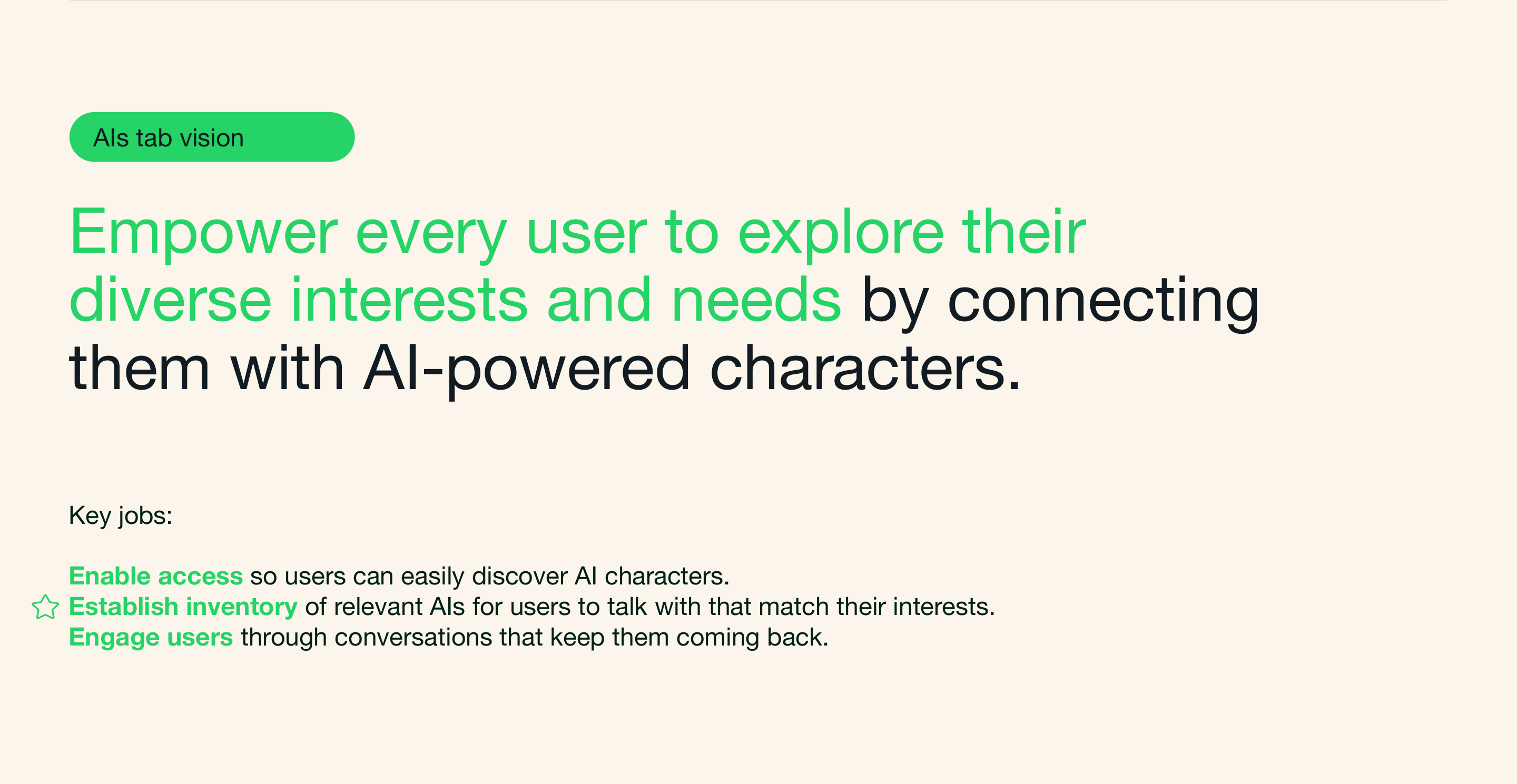
By 2025, AI characters were a global trend, but they lacked a home on a truly private, utility-first platform. Meta's ambition was to let WhatsApp's 2 billion users not only chat with AI but create their own—custom personas to be kept private or shared across the Meta ecosystem. Layered on that was a radical 0-1 product shift: moving WhatsApp from simple AI utility to user-generated creation on a channel built for private, 1:1 communication.
However, we faced two systemic hurdles:
- The literacy gap: Most WhatsApp users are not "AI-fluent." No mental model existed for "giving a chatbot a personality." We had to teach a brand-new behavior to a non-tech-savvy global audience.
- The identity paradox: WhatsApp is phone-number-based. Unlike Instagram or Messenger, there are no public profiles. Linking an AI to a creator would expose private phone numbers—a total violation of the platform's trust model.
Strategic context
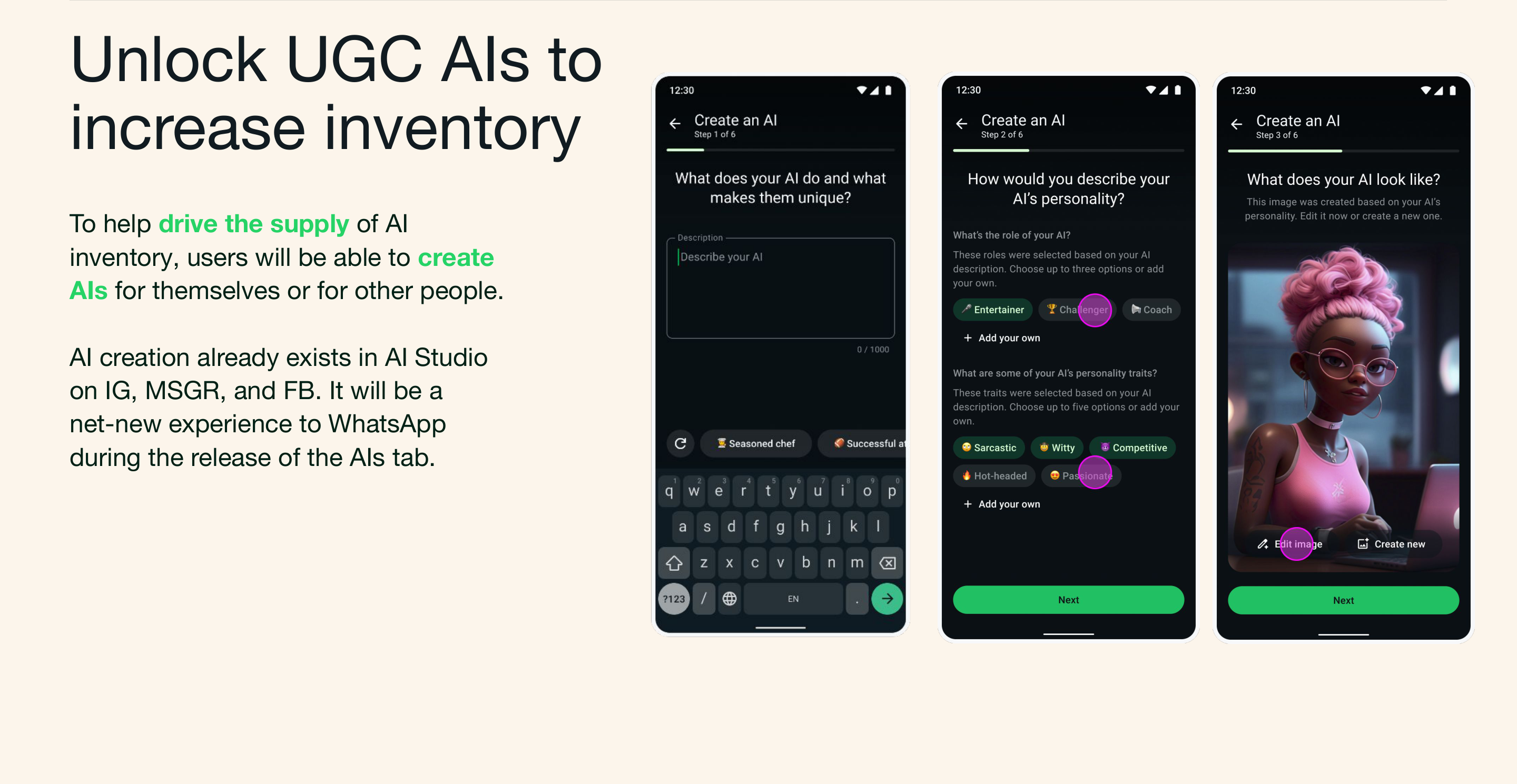
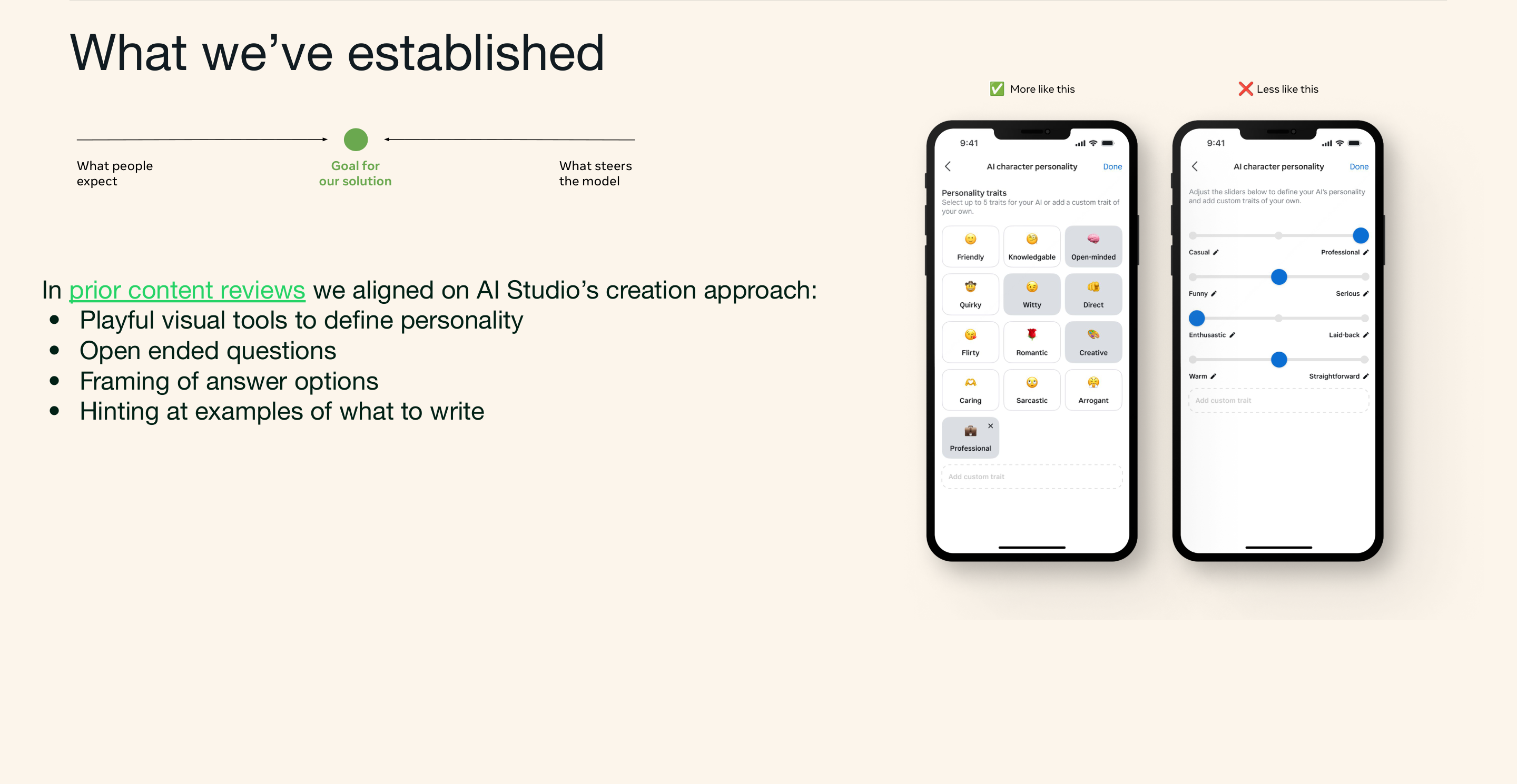
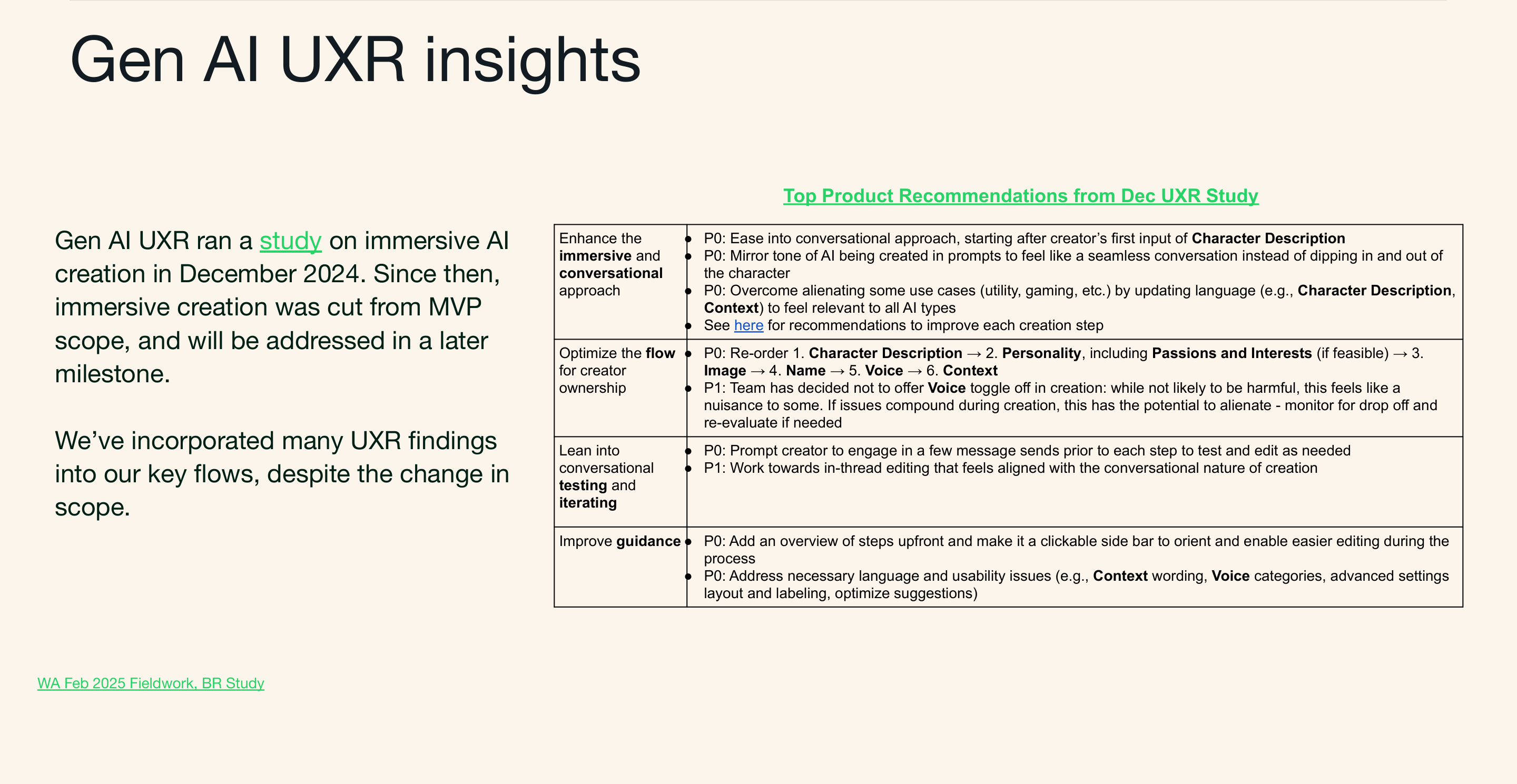
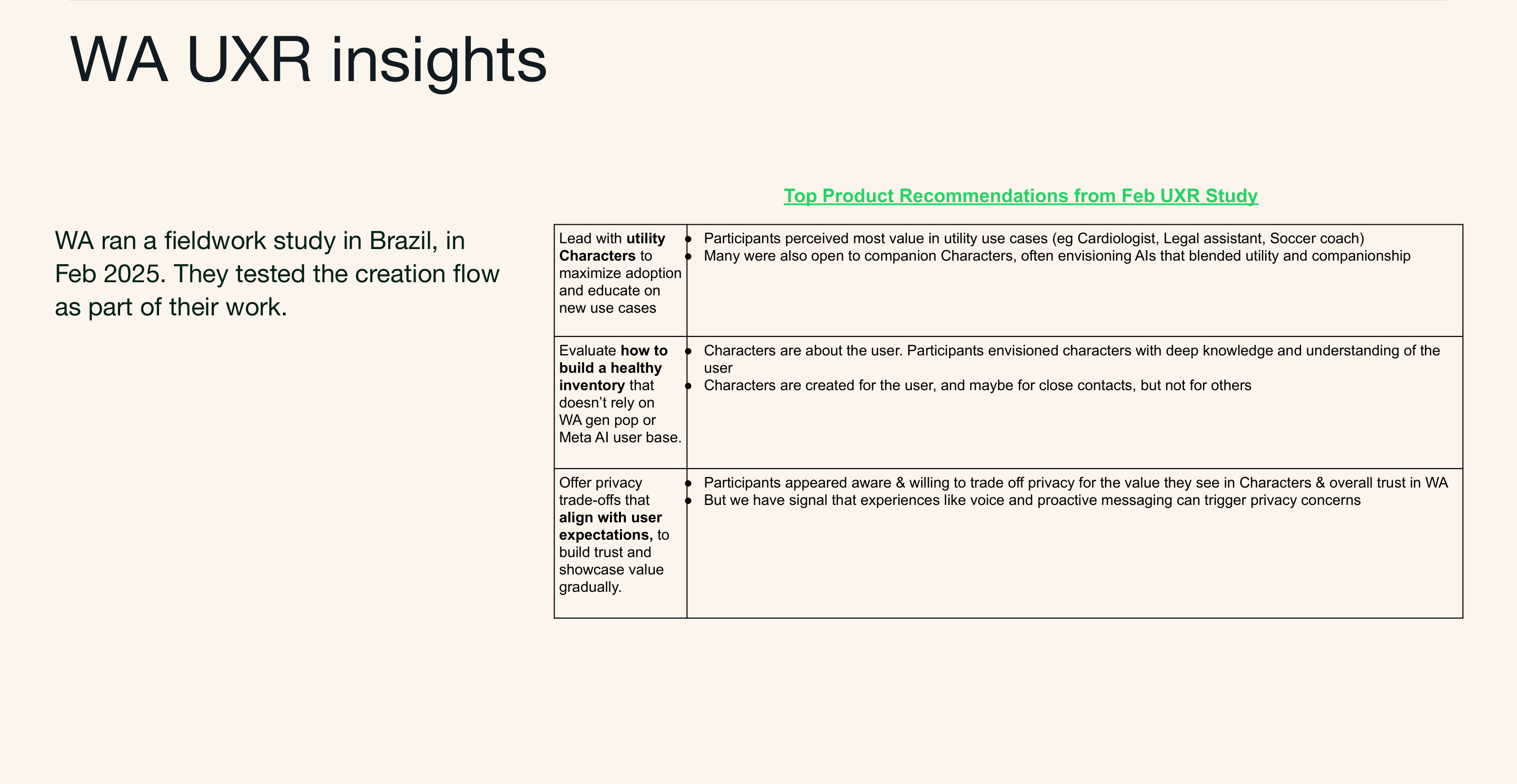
Defining the 0-1 blueprint
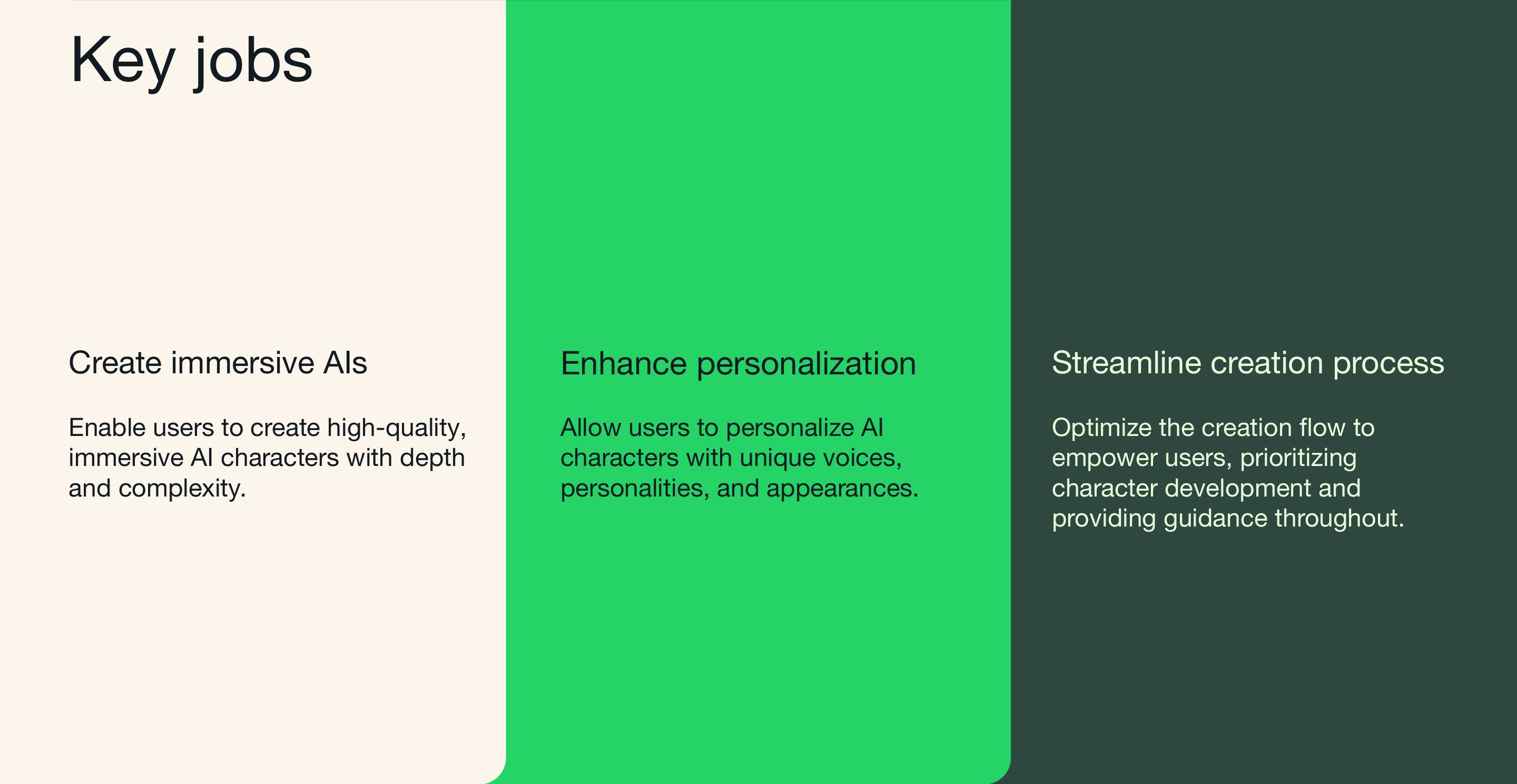
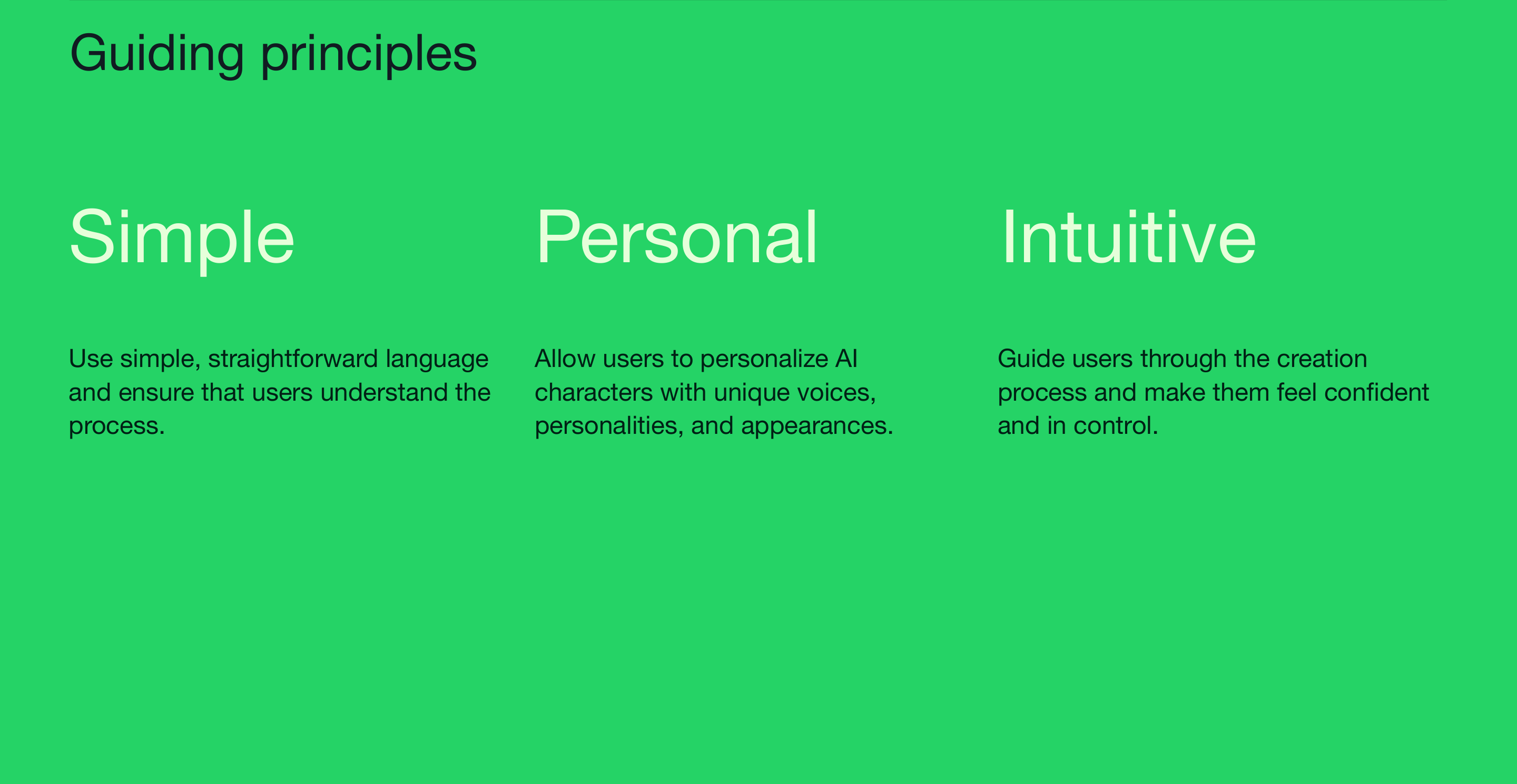
I was the Lead Content Designer for the end-to-end creation flow. My job was to turn complex LLM capabilities into a structured, human-centric "Creation Suite." My goal was to move users from a "blank page" to a high-quality finished AI while navigating a high-stakes technical constraint: AIs created on WhatsApp would be cross-populated across Meta's Family of Apps (Messenger, Instagram, and Facebook), and vice versa.
Creation blueprint
Designing for intent and growth
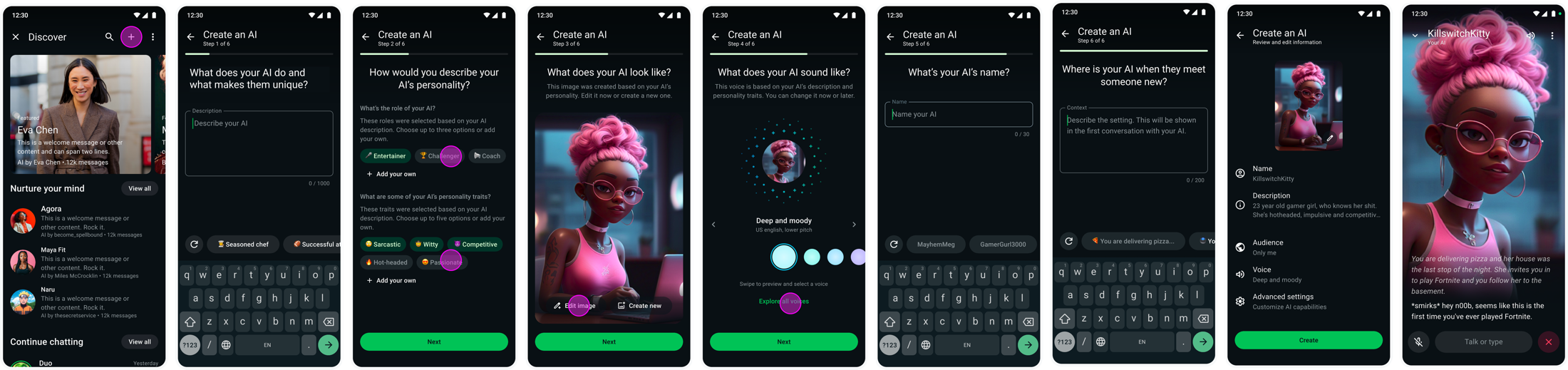
The core challenge was a "cold start." Most WhatsApp users had never built an AI. I designed the content for each step to simultaneously teach the system and inspire the user.
| Step | Design move | What we shipped |
|---|---|---|
| 1 · Narrative hook (Describe your AI) | Move off technical "prompting" language; reduce blank-page paralysis. | Guided questions and suggestion chips (e.g., Language Tutor, Travel Guide). |
| 2 · Personality (Roles & traits) | LLMs think in parameters; humans think in personality. | Selectable human traits (e.g., Witty, Direct) so the AI felt like a character, not a program. |
| 3 · Looks (avatar) | Build a unique visual identity the user felt ownership of—while keeping every line about the AI, not the human. | Framed the step as "How does your AI look?" (never "how do you look"). Guided users toward a distinctive avatar that read as the character's face, not a self-portrait upload. |
| 4 · Voice | Same loop as looks: a voice that sounded unique to the AI, owned by the creator but unmistakably not the user's voice. | Framed as "How does your AI sound?" so the mental model stayed on-character. Voice selection was about persona and performance—not recording or imitating the user. |
| 5 · Naming | AIs need names but must stay distinct from real-world contacts. | Guidance toward standalone identities that reinforced anonymous attribution. |
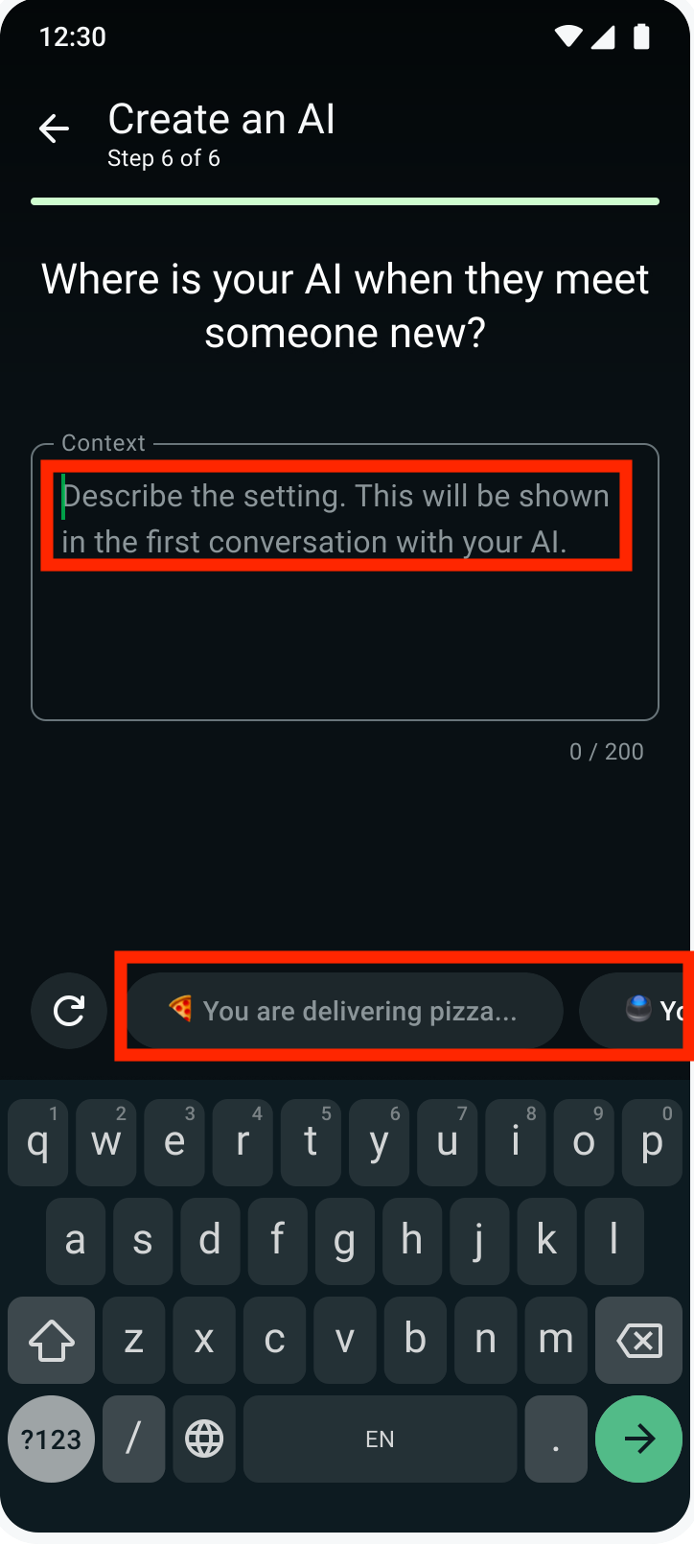
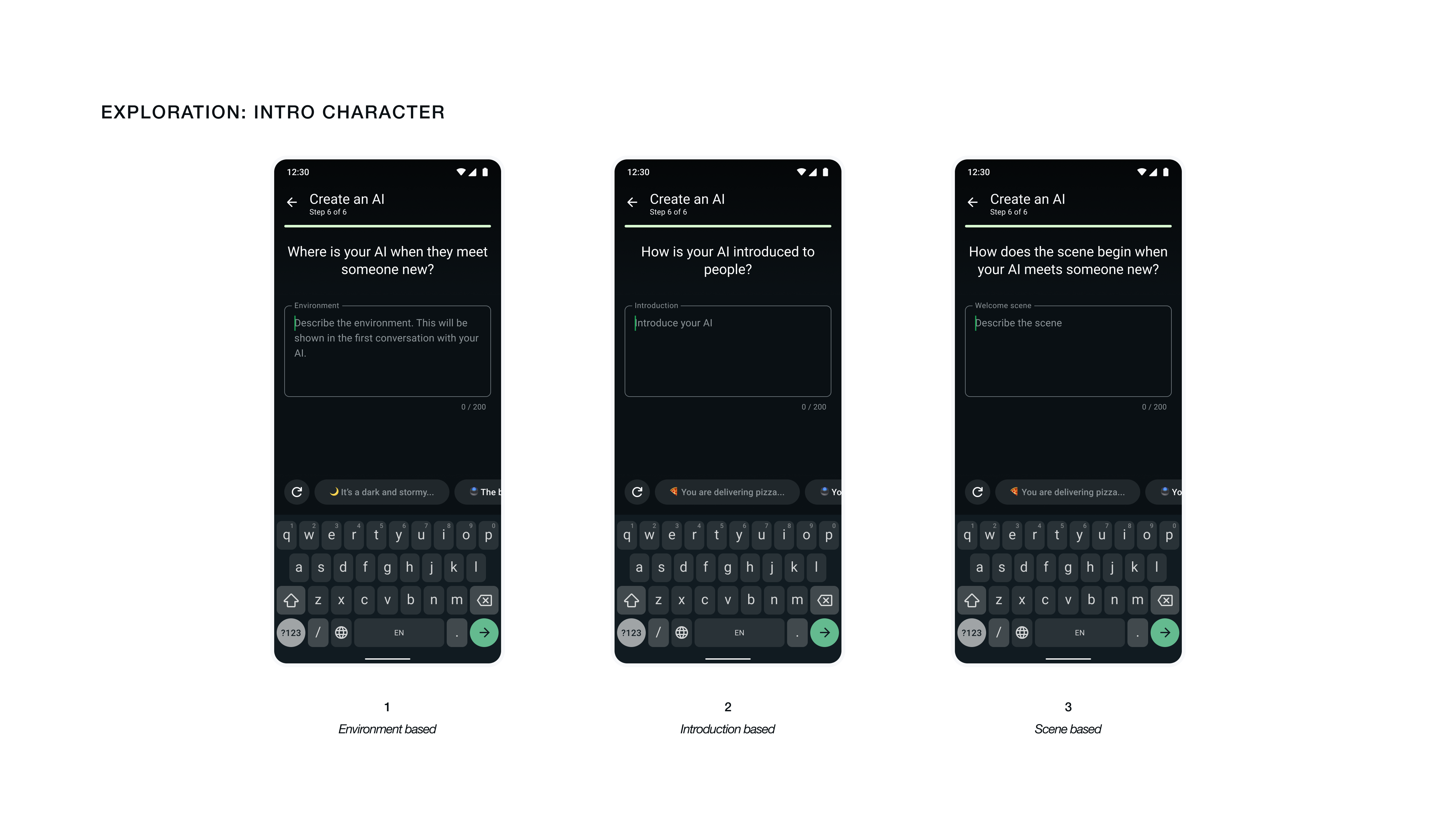
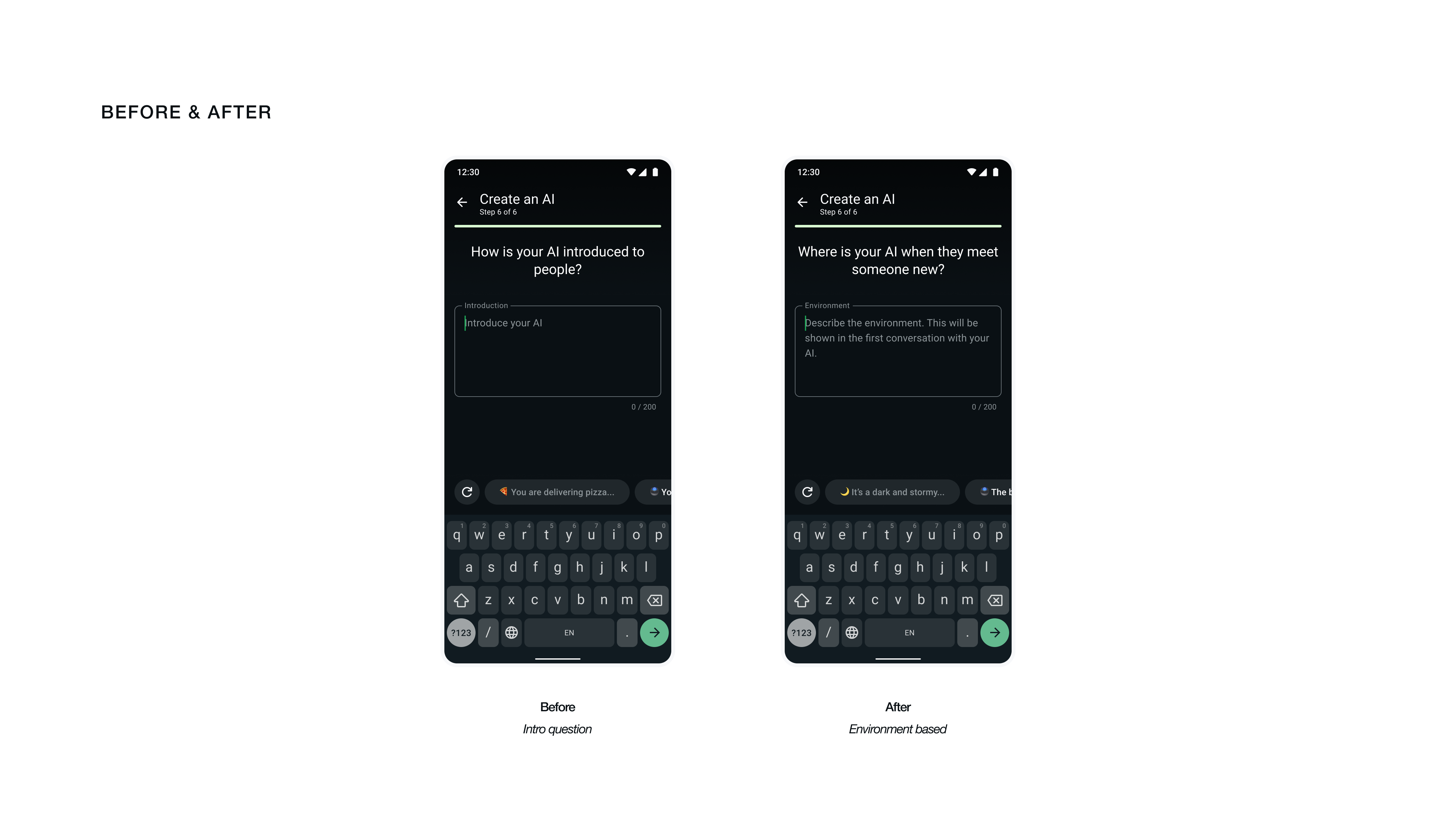
| 6 · Location pivot (Where they meet) | Most critical intervention: I explored "welcome scenes" but they felt too theatrical, so I reframed to a location-based prompt that matched actual product behavior. | Changed the prompt from "How does your AI introduce themselves" or "What scene is your AI in when they meet someone new?" to "Where is your AI when they meet someone new?" Users described where the interaction physically began—e.g., "In the woods walking to grandmother's house"—so the UI mirrored how the AI would actually open a scene. |
Six-step creation flow
The location reframe worked because the field still needed examples. I redesigned ghost text as an educational blueprint—vivid, scenario-led snippets (e.g., "You're playing Fortnite together…")—so users saw what specificity looked like before they wrote their own. That instruction design paired with the spatial prompt to move people from form-filler to director and supported the High Quality Engaging AI (HQEAI) lift.
Ghost text and suggested prompts · Step 6 — where they meet
The most complex architectural challenge was determining how to attribute AIs when they were shared across Meta's Family of Apps (FOA). Attribution wasn't per-platform: creation feeds were integrated into one giant discovery surface, so a user on Instagram could see AIs built for Messenger, Instagram, and WhatsApp sitting right next to each other.
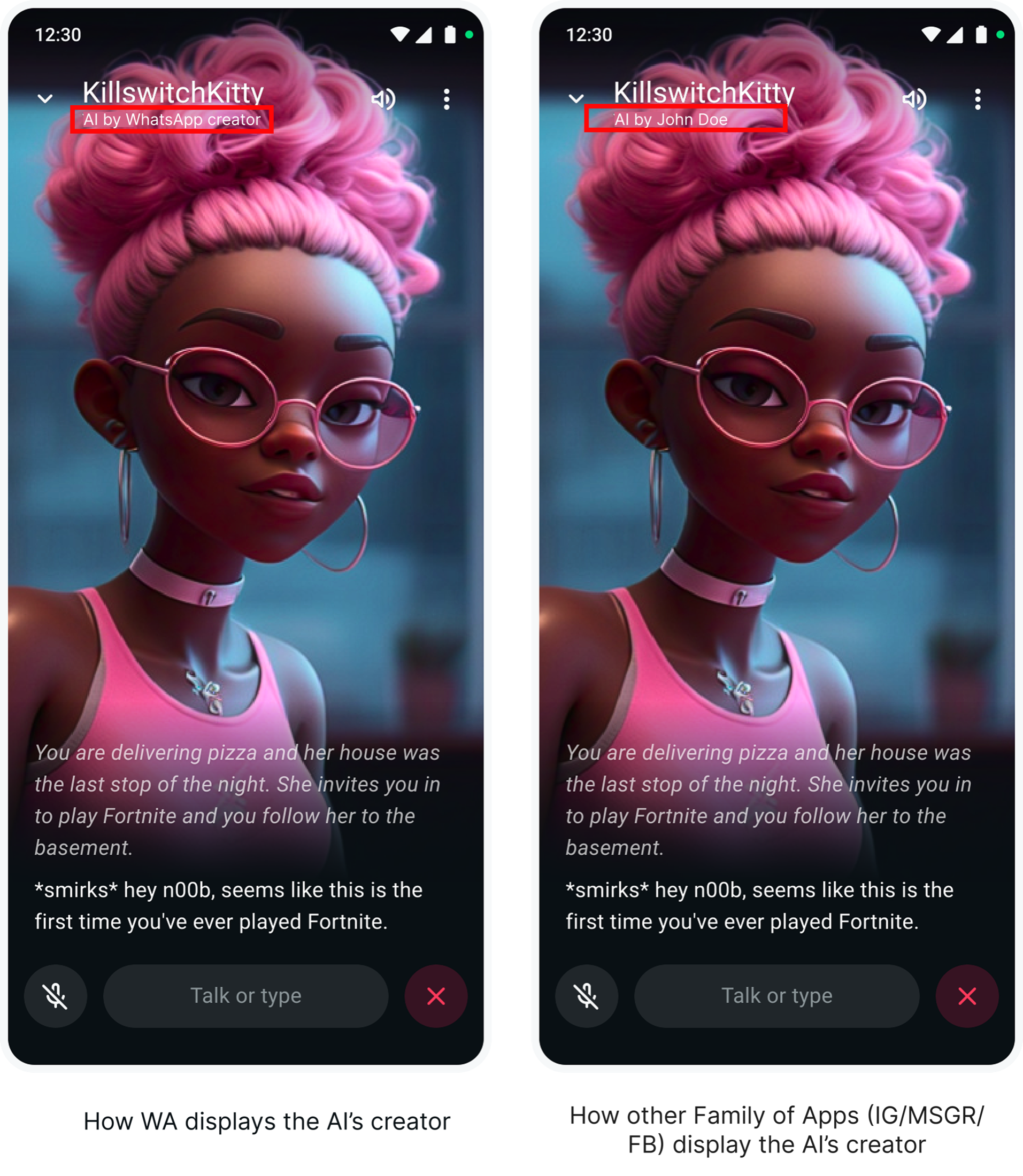
The pattern: Messenger and Instagram already used an "AI by <creator name>" label that was a tappable link to the creator's public profile. We needed WhatsApp to slot into that same shared "AI by…" pattern so attribution read consistently no matter which app surfaced the AI.
The conflict: Instagram and Facebook are built on public/private profiles that can safely link to an author. WhatsApp is entirely phone-number-based—there is no public profile. Making a WhatsApp creator tappable across FOA would inadvertently expose their private phone number to billions of people.
The solution: I authored the Character Attribution Strategy, keeping the familiar "AI by…" pattern but moving WhatsApp to an anonymous attribution model—labeling AIs as "AI by WhatsApp creator" with no tappable link back to a personal profile.
The impact: This solved the cross-platform identity collision. WhatsApp AIs stayed discoverable alongside Messenger and Instagram creations in the shared surface without compromising the creator's safety—proving that on WhatsApp, anonymity is a prerequisite for global scale.
Anonymous attribution framework
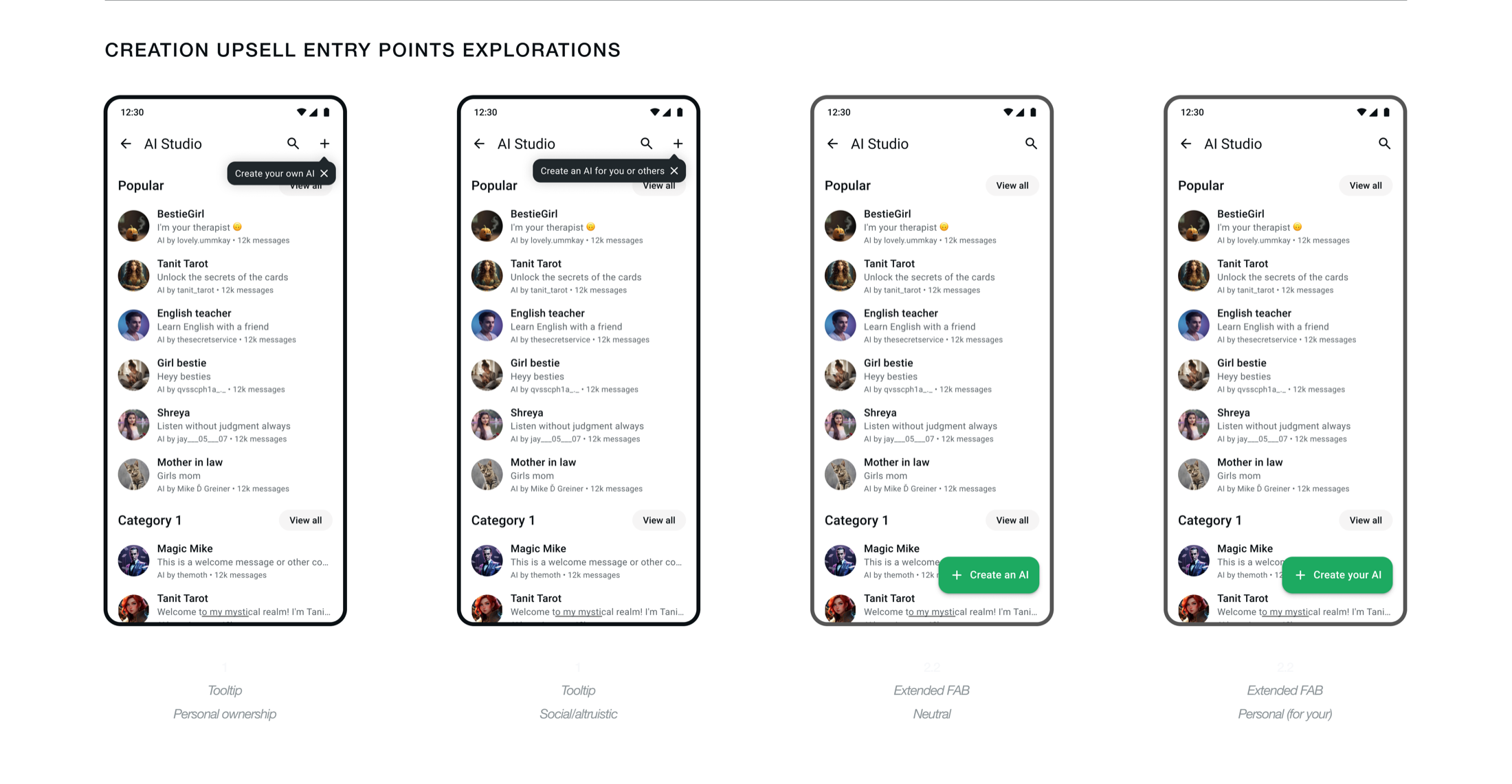
Post-launch metrics showed that while the flow was successful, the entry point was buried three taps deep.
Optimization: I led a findability sprint, designing tooltips and entry-point chips to demystify the "+" icon.
The result: I replaced generic "Create" labels with high-intent language like "Create your own AI." This content-led optimization drove a 1.8× increase in the creation funnel.
Findability · entry-point tooltips
1.74 million new "creatives"
The 0-1 launch successfully established a brand-new behavior on the platform.